
With the rapid development of LED display technology, displays are no longer limited to the traditional rectangular form. Custom-shaped LED displays, with their flexible designs and unique visual expressiveness, have gradually become a “new favorite” in scenarios such as commercial advertising, cultural venues, and entertainment places. This article will take you to a comprehensive understanding of custom-shaped LED displays from four dimensions: definition, classification, differences from conventional displays, and pricing.
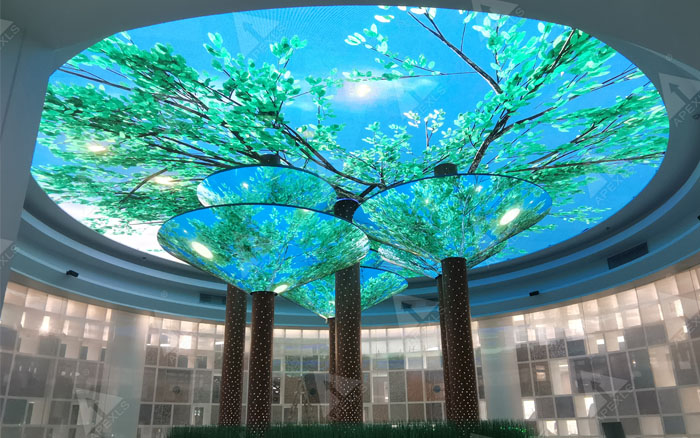
Apexls Creative LED chant screen
As the name implies, a custom-shaped LED display is an LED display product that breaks through the regular forms of traditional rectangles and squares and is customized into irregular shapes according to the needs of specific scenarios. With LED lamp beads as the core display unit, it can achieve display effects of complex shapes such as circles, arcs, triangles, waves, cylinders, and even imitations of animals and building outlines through modular splicing technology.
Compared with conventional displays, the core advantages of custom-shaped LED displays lie in “customization” and “scene integration”. It can break away from the constraints of flat and regular forms and deeply integrate with the architectural structure and spatial aesthetics of the installation environment. For example, it can be used as a curved dome screen fitting the atrium of a shopping mall, a display screen simulating the outline of a car, or a display device embedded in the irregular wall of an art gallery. Thus, it creates a more impactful and immersive visual experience and becomes an important carrier for conveying brand concepts and demonstrating cultural creativity.
According to the differences in design, installation methods, and application scenarios, custom-shaped LED displays can be divided into the following categories, each with its unique applicable scenarios:
This is one of the most common types of custom-shaped displays, including inner arcs, outer arcs, semicircles, and other forms. The curvature can be adjusted according to needs (such as a radius of 1 meter, 3 meters, etc.). Its core feature is that it can fit curved architectural structures (such as stadium stands, curved corridors in shopping malls) and avoid visual discontinuities caused by “right-angle turns” in the picture. It is commonly used in scenarios such as circular screens in large venues and curved advertising screens in subway passages.
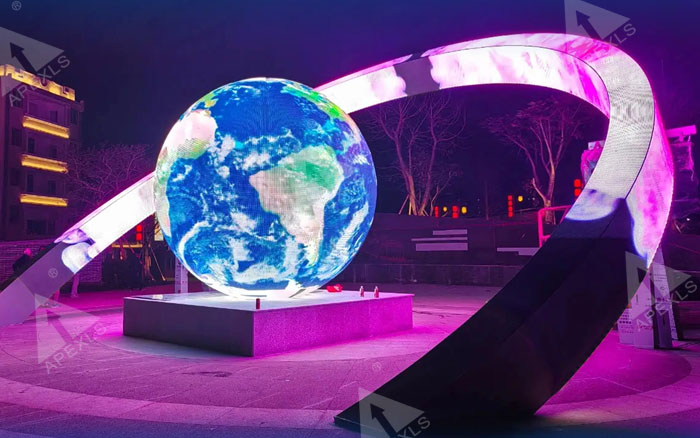
Apexls Creative LED display: spherical screen + annular screen
The whole display is circular or oval, which can be divided into “full circular screens” (such as an independent circular screen with a diameter of 2 meters) and “annular screens” (only the display area of the circular frame is retained, and the middle is a hollow structure). This type of display has a softer visual effect and is suitable for clock displays, brand logo displays (such as circular brand screens in the atrium of shopping malls), celestial simulation screens in science and technology museums, and other scenarios.
Breaking through the limitations of flat surfaces, they present three-dimensional forms, such as cylindrical screens, spherical screens, conical screens, and even customized three-dimensional screens that imitate the outlines of people, animals, and products (such as cars and wine bottles). For example, the spherical astronomical screen in a science and technology museum can simulate the cosmic starry sky, and the cylindrical screen in a brand exhibition hall can display product details in 360 degrees. This type of display has extremely high requirements for structural design and splicing accuracy and has the strongest visual impact.
Including asymmetric forms such as triangles, trapezoids, waves, and polygons, they are usually used in scenarios that pursue personalization such as art galleries and creative advertising walls. For example, the wavy wall screen in an art center can create a sense of flow with lighting, and the polygonal splicing screen in a commercial complex can break the monotony of the space and show a unique design style.
Strictly speaking, flexible screens are “basic products that can achieve custom-shaped effects”. Their screen bodies can be bent and folded, and can adapt to various installation scenarios such as curved surfaces and irregular planes. They can be spliced into arcs and waves, and can also fit three-dimensional structures such as cylinders and cones. Compared with custom-shaped screens with fixed shapes, flexible screens have higher flexibility and are suitable for temporary activities that need to adjust the shape frequently (such as exhibitions and stage performances).
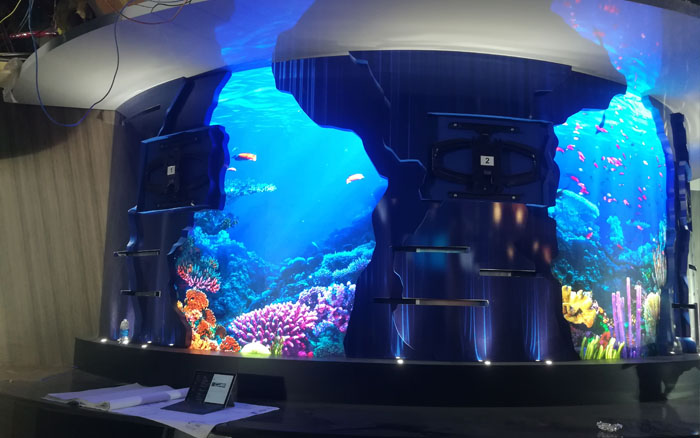
Apexls Bionic LED fish tank screen
Custom-shaped LED displays and traditional rectangular or square conventional displays have significant differences in core technology, application logic, installation difficulty, etc. The specific comparison can be made from the following 4 dimensions:
Conventional displays are produced in standard sizes (such as common 500mm×500mm, 600mm×600mm modules). Users can splice them into rectangular screens of different sizes according to needs without additional structural customization. However, custom-shaped LED displays are completely “customized on demand”. From the module shape (such as curved modules, triangular modules) to the overall frame (such as three-dimensional support structures), they all need to be designed separately according to the size, curvature, and spatial layout of the installation scenario, and there is no “universal model”.
The core function of conventional displays is to “display content clearly”, focusing more on basic parameters such as screen resolution and brightness. When installing, a regular flat space needs to be reserved for them (such as a rectangular area reserved on the wall), and visually, they are “independent display units”. However, custom-shaped LED displays are “visual elements integrated into the scene”. For example, a curved screen fitting the building dome will integrate the picture with the building structure, creating an immersive feeling of “space as a screen”, which is more suitable for scenarios pursuing creative expression.
The core of installing conventional displays is “module splicing” – you only need to splice the standard modules in order, connect the power supply and signals, and the technical threshold is low. However, the installation of custom-shaped LED displays is a “comprehensive project”: first, it is necessary to design a dedicated steel structure frame according to the scenario (such as a three-dimensional frame supporting a spherical screen) to ensure the stability of the screen body; second, it is necessary to customize special-shaped modules (such as the curvature of the curved module needs to match the frame) to avoid splicing gaps; finally, it is also necessary to perform “image correction” (such as adjusting the edge image of the curved screen to avoid distortion). The technical difficulty and installation cost are much higher than those of conventional displays.
Conventional displays are suitable for “general display needs”, such as rectangular conference screens in meeting rooms, rectangular advertising screens in shopping malls, and rectangular monitoring screens in monitoring rooms. The core demand is to “display information clearly and stably”. Custom-shaped LED displays are suitable for “characteristic scenarios”, such as art display screens in cultural venues (such as special-shaped cultural relic introduction screens in museums), creative advertising screens in commercial complexes (such as spherical brand screens at the entrance of shopping malls), and dynamic shape screens for stage performances (such as wavy background screens in concerts). The core demand is to “enhance visual appeal through shape”.
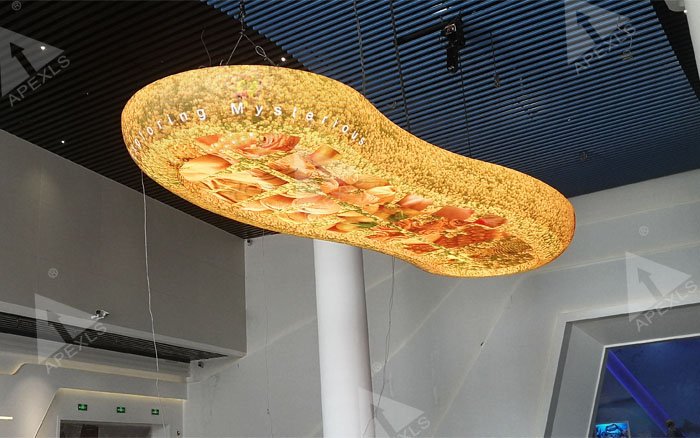
Apexls Creative LED large cloud screen
Different from conventional displays that are “priced per square meter” (for example, the price of conventional outdoor LED screens is 1000-1500 dollars/square meter), custom-shaped LED displays have no fixed price standard. Usually, the price ranges from 1200 dollars/square meter to 3,000 dollars/square meter, and even the price of products with complex shapes is higher. The core influencing factors include the following 4 points:
This is a core factor affecting the price of custom-shaped screens. For example, a simple curved screen (with small curvature and regular shape) only needs to customize curved modules, and the price is relatively low (about 1,000-2,000 dollars/square meter). However, spherical screens and three-dimensional product-shaped screens (such as screens imitating cars) need to customize three-dimensional frames and special-shaped modules, and have extremely high requirements for splicing accuracy (for example, the spherical screen needs to ensure that the curvature of each module is consistent to avoid image dislocation). The design and production cycle is long, and the price can reach 2,000-4,000 yuan/square meter or even higher.
Conventional displays use standard modules, and mass production reduces the cost. However, custom-shaped screens need to be customized with “special-shaped modules” (such as triangular modules, curved modules). More material waste will be generated during the production process (such as waste materials when cutting modules), and the production efficiency is low (mass assembly line production is not possible), resulting in the module cost being 30%-50% higher than that of standard modules. In addition, the steel structure frame and fixed accessories of custom-shaped screens (such as special buckles for curved screens) also need to be customized, which further increases the cost.
Similar to conventional screens, resolution (pixel pitch) also affects the price of custom-shaped screens. The smaller the pixel pitch (such as P2.5, P3, which means more pixels per millimeter), the clearer the picture, but the higher the lamp bead density and the higher the cost. For example, for the same curved screen, the price of the P3 model (pixel pitch 3mm) is about 6,000-9,000 yuan/square meter, while the price of the P1.8 model (pixel pitch 1.8mm) may reach 10,000-15,000 yuan/square meter.
As mentioned earlier, the installation of custom-shaped screens is a “comprehensive project”, which requires a professional team to design the steel structure, conduct on-site splicing, and perform image correction. It may even be necessary to coordinate with the construction party to adjust the installation environment (such as reinforcing the wall and reserving power interfaces). The installation and debugging cost usually accounts for 20%-40% of the total cost, which is much higher than that of conventional screens (the installation cost of conventional screens only accounts for 5%-10%). For example, for a 10-square-meter spherical screen, the installation and debugging cost alone may reach 3,000-9,000 dollars.
In addition, the brand and after-sales service (such as the warranty period and on-site maintenance) will also affect the price. Products of first-tier brands have mature technology and stable quality, so their prices are 10%-20% higher than those of small brands. However, their after-sales support is more complete, which is suitable for scenarios with high requirements for display effects and stability (such as large venues and long-term commercial displays).
Custom-shaped LED displays are the product of the combination of technology and creativity. They break the form limitations of conventional displays and provide more personalized visual solutions for different scenarios. However, their customized nature also determines that their price and installation complexity are higher than those of conventional displays. When choosing, users need to comprehensively evaluate core factors such as shape complexity and resolution based on their own scenario needs and budget to select the most suitable product.