
In today’s commercial spaces, public architecture, cultural landmarks, and brand flagships, LED displays are no longer limited to rectangular screens mounted on flat walls. Designers increasingly push boundaries with irregular shapes, curved surfaces, transparent structures, and immersive installations that blur the line between art and technology.
However, behind every visually stunning, creative custom LED display lies a complex engineering system. While the audience sees fluid visuals and bold forms, engineers confront challenges related to structure, signal stability, power reliability, and content accuracy. Without robust technical foundations, even the most striking LED concept risks distortion, failure, or costly redesign.
For Apexls, delivering creative custom LED displays means managing these hidden technical layers with precision. This article explores five essential “technical undercurrents” that support irregular LED projects—from concept validation to long-term operation—ensuring that artistic ambition translates into reliable, high-performance reality.
Creative LED displays have evolved rapidly in recent years. Architects and brands now demand screens that wrap around columns, flow across curved facades, float transparently in storefronts, or form sculptural centerpieces in public spaces.
These demands stem from several trends:
Experiential marketing requires immersive visual storytelling.
Architectural integration seeks harmony between digital media and physical form.
Urban landmarks aim to create iconic, shareable visuals.
As a result, creative custom LED displays now include curved LED screens, cylindrical installations, wave-shaped walls, transparent LED facades, and free-form geometries that defy conventional panel layouts.
Yet as geometry becomes irregular, engineering complexity increases exponentially. Success depends not on appearance alone, but on whether the hidden technical systems can sustain performance over time.
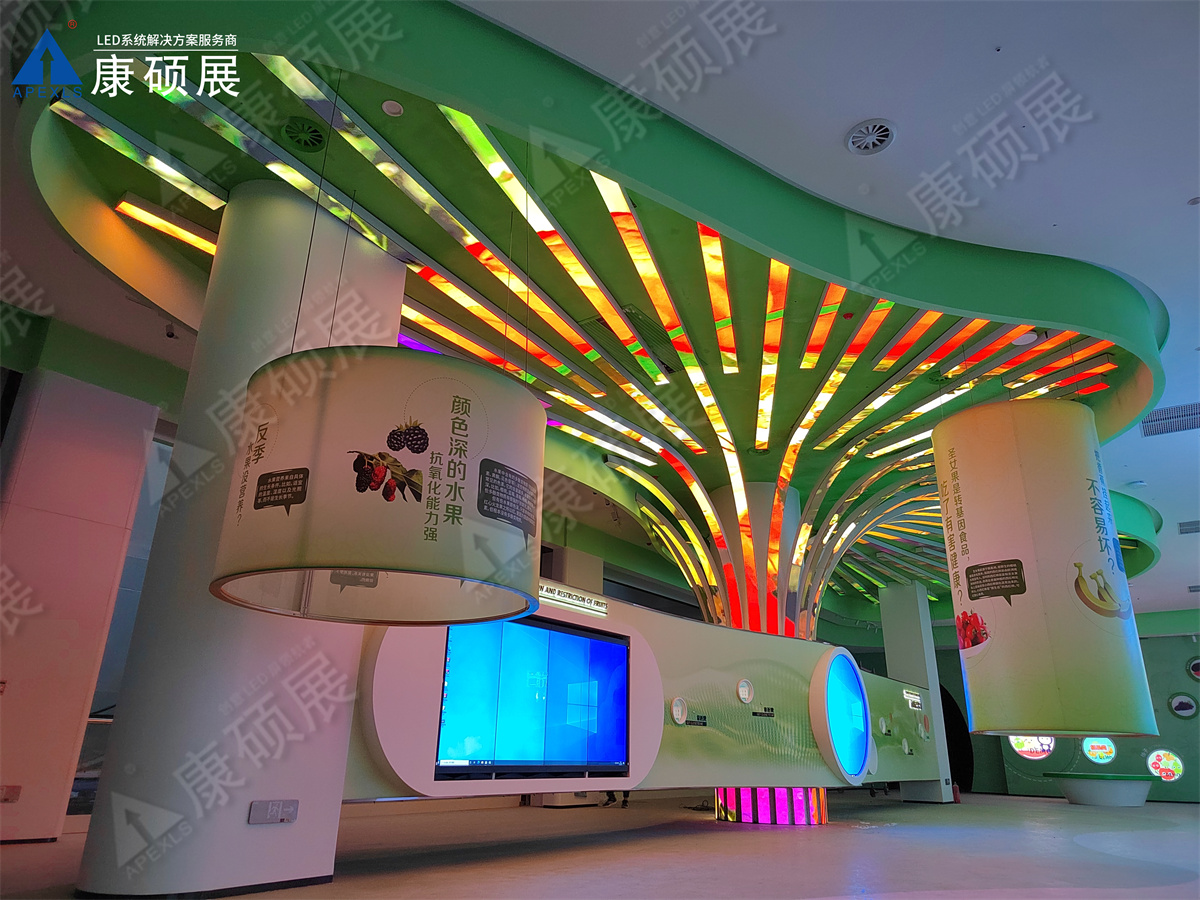
In standard LED walls, structure design follows predictable rules. However, irregular LED displays introduce asymmetric loads, unconventional mounting points, and non-uniform stress distribution. Gravity, wind, vibration, and thermal expansion all affect stability.
Without accurate structural mechanics analysis, creative installations risk deformation, module misalignment, or even safety hazards.
For creative custom LED displays, structural design begins with:
Finite element analysis (FEA) to model stress distribution
Load path planning to ensure forces transfer safely to building structures
Material selection optimized for strength-to-weight ratios
Curved and suspended LED screens require customized steel or aluminum frameworks that maintain rigidity without excessive weight. Transparent LED displays further complicate design because structural elements must remain visually unobtrusive while still providing sufficient support.
Traditional LED modules assume flat, rectangular grids. In contrast, creative custom LED displays often demand variable angles, radii, or spacing. Using standard modules in such scenarios leads to gaps, uneven seams, or forced compromises in visual continuity.
Special module design allows creative forms to exist without distortion. This includes:
Flexible LED modules that adapt to curved surfaces
Beveled or angled cabinets that maintain seamless joints
For cylindrical or wave-shaped displays, precise module geometry ensures that pixel pitch remains consistent across curves. This consistency prevents visual stretching and preserves content integrity.
From a product perspective, custom module engineering transforms creative LED displays from conceptual sketches into buildable systems.
In conventional LED screens, signal routing follows linear patterns. However, creative custom LED displays often feature branching layouts, varying module orientations, and non-linear shapes. If signal topology remains unoptimized, issues such as latency differences, data loss, or partial image failure can occur.
Signal topology optimization treats the LED system as a network rather than a chain. Engineers map:
Shortest and most balanced data paths
Redundant signal loops for fault tolerance
Load distribution across receiving cards
Curved and irregular screens benefit from distributed signal architectures that minimize cable length differences and maintain synchronized refresh across the entire surface.
Irregular LED displays often operate in high-profile public spaces where downtime is unacceptable. Power instability poses a significant risk, especially when displays are integrated into architectural structures.
Creative LED installations frequently feature:
Distributed power zones
Limited access for maintenance
Continuous long-term operation
To mitigate risk, professional creative custom LED displays incorporate:
Dual power supplies at the cabinet level
Independent power circuits for critical zones
Automatic failover mechanisms
Additionally, thermal management becomes more complex in irregular designs. Curved and enclosed structures restrict airflow, increasing heat accumulation. Engineers must plan ventilation paths, heat dissipation materials, and intelligent power distribution to maintain stable operating temperatures.
These measures protect both performance and lifespan, ensuring that creativity does not come at the cost of reliability.
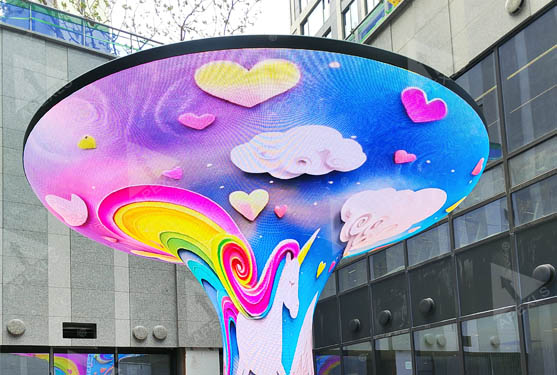
Content that looks perfect on a flat screen may distort dramatically on curved, angled, or transparent LED displays. Without professional mapping, visuals lose alignment, proportions shift, and immersion breaks.
Professional content calibration addresses these challenges through:
Geometric correction that adapts visuals to physical shape
Brightness and color uniformity calibration across irregular surfaces
Viewing-angle optimization for the audience perspective
For transparent LED displays, calibration must also balance brightness with background visibility. Engineers fine-tune transparency ratios to ensure legibility without blocking architectural features.
This final technical layer ensures that creative custom LED displays deliver not just structural success, but also visual excellence.
Creative LED projects carry inherent risk due to their uniqueness. Effective risk management requires a system-level approach:
Concept Validation – Engineering feasibility checks before design finalization
Prototype Testing – Module and structure validation in controlled environments
Installation Simulation – Signal and power stress testing
On-Site Calibration – Final adjustments under real conditions

In the market for creative custom LED displays, visual impact often dominates early conversations. However, long-term success depends on invisible engineering decisions that prevent failure, reduce maintenance, and preserve artistic intent.
Clients increasingly recognize that:
Engineering-backed creativity delivers consistent performance
Robust systems lower the total cost of ownership
Reliable installations protect brand and architectural reputation
Therefore, the true value of a creative LED supplier lies not only in design inspiration but also in technical mastery.
When art meets engineering, creative custom LED displays reach their full potential. Irregular shapes, curved surfaces, and transparent structures captivate audiences, but only when supported by rigorous technical systems.
Structural mechanics, special module design, optimized signal topology, power redundancy, and professional content calibration form the five hidden foundations that safeguard creative LED projects. By addressing these factors proactively, Apexls transforms bold ideas into reliable, long-lasting installations.
In the end, the most successful creative LED displays are those where audiences see only beauty—while engineering quietly ensures that everything works flawlessly behind the scenes.