
For decades, the digital display was confined to the “box”—a rigid, rectangular frame bolted onto a flat wall. This traditional approach treated the screen as an intrusion, a foreign object that competed with the building’s architecture rather than complementing it. However, a significant paradigm shift is occurring in the world of urban design and commercial aesthetics. By utilizing irregular LED display panels, architects and designers are finally breaking the “rectangular prison.”
Today, LED technology is no longer an appendage; it has become the “Dynamic Skin” of the building. Through the use of curves, spheres, waves, and bespoke geometric modules, creative displays can now hug the organic contours of a structure. This integration redefines the building’s visual identity, turning static facades into breathing, emotional media that serve as a “Secondary Contour Light” in the night sky. This article explores how irregular LED modules are reconstructing the commercial value and architectural soul of modern landmarks.
In traditional urban environments, the screen often acts as a “frame on a wall,” creating a jarring visual disconnect. Architecture is frequently defined by soft curves, bold angles, and flowing lines—elements that a standard flat LED panel simply cannot respect.
Irregular LED display panels allow for a seamless “merger” between digital media and physical structure. When a display can wrap around a cylindrical column or flow along a serpentine roofline, it ceases to look like a screen and begins to look like a luminous material. This harmony ensures that the digital content feels like it is “emerging” from the building’s DNA rather than being stuck on its surface.
During the day, a building is defined by its material and shadow. At night, it often disappears into the darkness, lit only by static spotlights. By integrating freeform LED modules as a “Secondary Contour,” the building acquires a second life. It can pulse with the rhythm of the city, change colors to reflect the season, or display abstract art that reinforces its iconic status.
The engineering behind “irregularity” is far more complex than standard manufacturing. It requires a fundamental redesign of the PCB (Printed Circuit Board) and the cabinet structure.
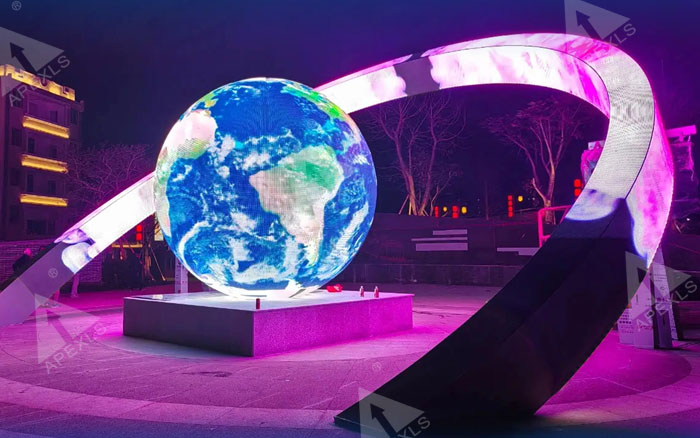
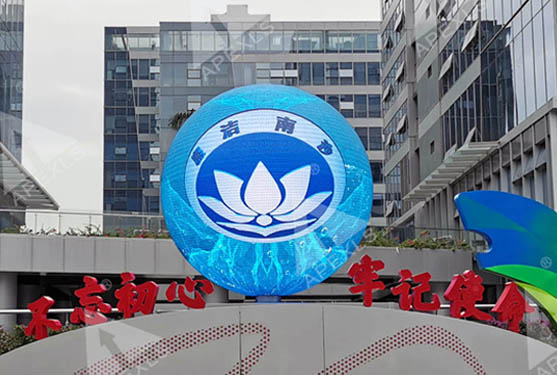
The sphere is the ultimate challenge in display technology. Standard square panels cannot form a perfect ball without massive gaps or distortion. Bespoke irregular LED display panels, shaped like triangles or trapezoids, solve this problem. These “pixel-perfect” modules allow for a 360-degree viewing experience, turning a landmark into a glowing orb of light. This is particularly effective for science museums, planetariums, and high-end retail flagships.
Flexible substrates allow LED panels to “flow.” By using soft PCB materials, manufacturers can create screens that mimic the movement of water or silk. These “ribbons of light” can follow the winding path of a grand staircase or the undulating waves of a modern ceiling. Consequently, the screen becomes an extension of the interior or exterior design language, providing a tactile, liquid visual experience.
A “Dynamic Skin” is more than just a surface that plays video. It is a communicative layer that allows a building to express “emotions” or react to its environment.
Using irregular LED display panels, designers can create “breathing” patterns—slow, rhythmic pulses of light that mimic a biological heartbeat. For a corporate headquarters, this might translate into cool, steady blue tones that communicate stability. For a luxury hotel, it might mean warm, amber “ripples” that welcome guests. This emotional intelligence turns a cold, concrete structure into a living entity that engages with the public on a subconscious level.
Modern creative LEDs often utilize “strip” or “mesh” designs. These irregular formats provide high transparency (often over 70%), allowing natural light to enter the building during the day while transforming the facade into a high-definition media surface at night. This ensures that the “Dynamic Skin” does not compromise the comfort of the people inside the building.
In a crowded urban landscape, attention is the most valuable currency. Irregular displays provide a “Visual Magnetism” that standard billboards cannot match.
People are naturally drawn to patterns that break expectations. A rectangular screen is predictable; a giant, 3D LED “diamond” or a “digital waterfall” that pours down a building’s corner is a viral sensation. This “Landmark Effect” significantly boosts the commercial value of the property. It increases foot traffic for retail tenants and allows building owners to command premium rates for advertising and sponsorship.
For a brand, the building itself becomes the logo. By using irregular LED display panels to highlight the unique architectural silhouette of a headquarters, the brand cements its identity in the minds of the public. The building doesn’t just “show” the brand; the building is the brand.
The success of a creative LED installation depends on the precision of the “joinery.” In irregular designs, every millimeter counts.
Seamless Splicing: Unlike standard cabinets, irregular modules require bespoke frames that ensure no visible “seams” exist between curves or angles. This creates a “monolithic” light surface.
Custom GOB/COB Coating: To protect these unique modules in outdoor or high-traffic indoor environments, specialized coatings (Glue-on-Board or Chip-on-Board) are used. These provide waterproofing and impact resistance while maintaining high optical clarity on complex surfaces.
Distributed Control Systems: Managing content on a non-rectangular canvas requires advanced mapping software. Technicians use “pixel mapping” to ensure that an image flowing across a spherical or wavy surface does not appear stretched or distorted.
The evolution of irregular LED display panels marks the end of the era where digital media and physical architecture were two separate disciplines. By leaping beyond the rectangle, we have entered a world where the building itself is the medium.
These creative modules provide architects with a “digital paintbrush” capable of defining a structure’s second skin and its nighttime soul. Whether it is a glowing sphere in a city center or a flowing ribbon of light in a hotel lobby, irregular LEDs transform static spaces into dynamic experiences. They don’t just decorate the building; they give it a voice, a personality, and a permanent place in the visual memory of the city. In the pursuit of the iconic, the rectangle is no longer enough—the future belongs to the curve.