

In the realm of contemporary architectural design, a corridor is rarely just a transition between two points. Instead, it serves as a psychological “threshold”—a space where the viewer’s mindset shifts from one environment to another. When these transitional spaces take a circular or curved form, they offer a unique opportunity for immersive storytelling. By integrating inner arc LED displays, architects and experience designers can convert static hallways into “Liquid Narratives.”
Unlike flat screens that command attention from a single focal point, an inner arc screen wraps around the viewer, utilizing the natural periphery of human vision. This physical embrace turns a simple walk into a guided spatial exploration. This article examines how the unique morphology of the inner arc screen, combined with dynamic content design, transforms circular architectural channels into flowing scrolls of light and information.
The human eye does not perceive the world in a flat 16:9 ratio. Our field of vision is naturally curved, a fact that makes inner arc LED displays inherently more “comfortable” and immersive than their flat counterparts.
When a viewer enters a corridor lined with an inner arc screen, the display “wraps” around them. This creates a sense of being inside the content rather than standing in front of it. In a museum or high-end showroom, this physiological embrace lowers the viewer’s defensive barriers, making them more receptive to the brand’s story or the exhibition’s historical message.
Flat screens in a curved hallway create “visual friction”—harsh edges and gaps that break the illusion of continuity. Conversely, an inner arc configuration provides a seamless, uninterrupted surface. This continuity allows the brain to perceive the digital content as a physical extension of the architecture itself, rather than a tacked-on electronic appliance.
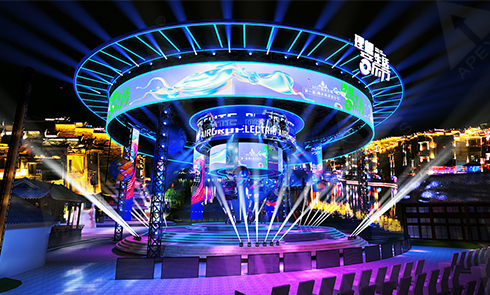
Historically, storytelling was often depicted on long physical scrolls or panoramic murals. Inner arc LED displays act as the 21st-century digital equivalent of these ancient narrative tools.
Imagine a circular “Product Walk” in a luxury automotive showroom. As the customer walks along the curve, the inner arc screen displays the vehicle’s engineering soul.
Segmented Flow: At the start of the curve, the screen shows raw materials and design sketches.
Dynamic Pacing: As the customer moves deeper into the curve, the visuals transition into high-speed driving footage that “races” alongside the viewer.
Guided Exploration: The screen uses movement to pull the visitor forward, turning a passive walk into an active discovery of the car’s features.
For historical museums, an inner arc corridor functions as a “Time Tunnel.” The curved surface allows for a chronological timeline that flows like a river. Because the screen is concave, the viewer can see “the past” in their peripheral vision as they look toward “the future,” creating a profound sense of historical context that a flat wall cannot achieve.
Achieving a perfect “Flowing Scroll” requires more than just bending a panel. It requires a synergy of mechanical precision and electronic calibration.
Creative inner arc LED displays utilize specialized triangular or trapezoidal modules. These shapes allow the panels to join at micro-angles, creating a smooth, circular curve without “faceting” (the jagged look of flat panels trying to form a circle). This mechanical accuracy ensures that when a horizontal line of light moves across the screen, it remains perfectly straight and unbroken.
One of the greatest challenges of a concave screen is the “sweet spot.” In an inner arc design, the light from different parts of the screen converges toward the center of the corridor. Engineers must calibrate the brightness and color consistency so that no matter where the viewer stands within the arc, the colors remain vibrant and the contrast stays deep.
To make an inner arc corridor feel like a “Liquid Narrative,” the digital content must respect the physics of the curve.
Parallax Pacing: Designers can create layers of content that move at different speeds. The background “distant” mountains move slowly, while “foreground” elements zip by. This reinforces the viewer’s sense of movement as they walk through the hallway.
Directional Guidance: Content can act as a silent usher. A “stream” of golden light flowing along the bottom of the arc can subconsciously lead visitors toward a specific exit or the next exhibit hall.
Peripheral Awareness: By placing high-detail info-graphics at eye level and atmospheric “mood” content in the peripheral areas, the screen manages the viewer’s cognitive load, preventing sensory overwhelm.
The next evolution of inner arc LED displays involves interactivity. By integrating LiDAR or infrared sensors, the curved corridor becomes responsive.
As a visitor walks, the content on the inner arc screen can follow them. A digital school of fish might swim around the visitor’s feet, or a “digital shadow” of a historical figure could walk alongside them on the screen. This interaction erases the line between the physical person and the digital story, creating an unforgettable “one-to-one” brand experience.
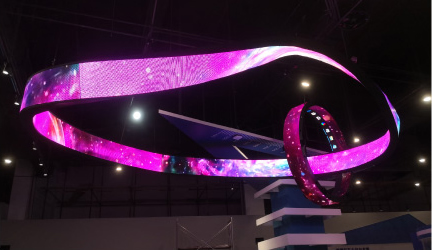
Investing in a high-end inner arc installation is a strategic move to increase the “dwell time” and “emotional recall” of a space.
Dwell Time: Immersive corridors encourage people to walk more slowly and observe more. In retail environments, this translates to higher brand engagement.
Viral Shareability: Curved, glowing architectural spaces are inherently “Instagrammable.” A well-designed inner arc corridor becomes a social media magnet, providing the brand with organic, high-reach marketing.
Future-Proofing: Physical renovations are expensive. A digital inner arc skin allows a building to change its “interior soul” every season with just a software update, keeping the space fresh for decades.
The inner arc LED displays are not just screens; they are a new form of “Architectural Media” that speaks to the viewer. By embracing the human form and the circularity of movement, these displays turn a simple corridor into a living, breathing narrative.
Whether it is the high-octane energy of a car showroom or the solemn reflection of a museum, the inner arc screen ensures that the story doesn’t just sit on a wall—it flows, it guides, and it surrounds. In the future of smart architecture, the most powerful stories will not be told on pages or flat screens, but within the flowing, glowing curves of the spaces we inhabit.