A plain-English guide to the latest non Gamstop casinos UK 2026, covering offshore licences, no deposit bonuses, real brands, and what to check before you deposit. read the latest non Gamstop casino guide

In the modern urban landscape, the sky is often a forgotten dimension. Hemmed in by concrete canyons and artificial light, city dwellers live in a state of perpetual “sensory noise,” leading to rising levels of chronic anxiety and mental fatigue. While traditional entertainment focuses on stimulation, a new architectural movement is emerging that seeks the opposite: restoration.
By utilizing high-definition creative modular LED displays to construct massive, immersive ceiling installations—often referred to as LED Canopies or Skyscreens—designers are creating “Mental Decompression Chambers.” These installations do more than show images; they reconstruct scientifically-proven soothing environments like the Aurora Borealis, deep-sea forests, or sunset wildernesses. This article explores how LED technology, when used as a therapeutic tool, can repair the psychological energy of modern citizens, transforming public spaces into sanctuaries of healing.
Modern psychology often cites Attention Restoration Theory (ART), which suggests that urban environments drain our “directed attention” resources. To recover, the human brain requires “soft fascination”—the kind provided by nature, where the eyes can wander without the stress of processing complex information.
For most urbanites, the opportunity to sit under a clear starlit sky or watch a rainstorm in a forest is a rare luxury.
The Psychological Barrier: The lack of access to vast, open horizons contributes to a feeling of claustrophobia and heightened cortisol levels.
The Tech Intervention: Creative modular LED displays fill this biological gap. By bringing the “outside in,” these screens act as a surrogate for the natural world, providing the expansive visual cues that tell our nervous system it is safe to relax.
Creating a “Decompression Chamber” requires more than just a large screen. It requires the technical precision to replicate the subtle physics of the natural world.
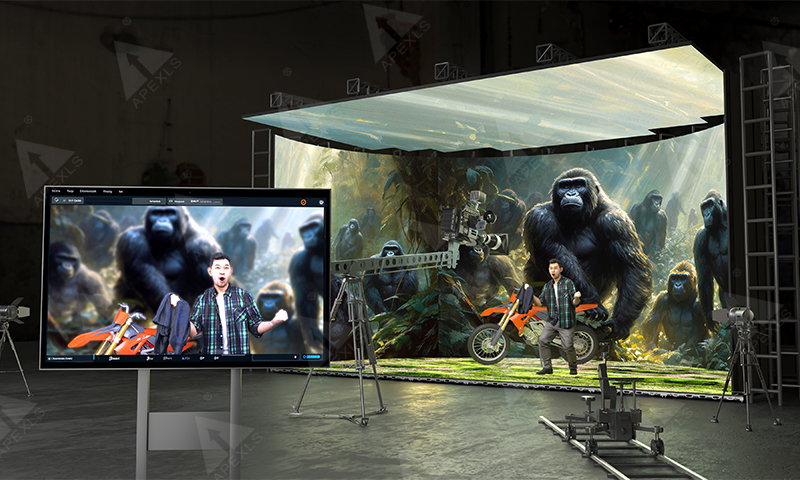
To achieve a therapeutic effect, the digital sky must be indistinguishable from the real one.
Seamless Immersion: Modular LED panels allow for the creation of massive, curved surfaces without any distracting bezels. This visual continuity is essential for the “sink-in” feeling of immersion.
Gradual Light Transitions: The soft glow of a sunrise or the shimmering of a nebula requires extreme color depth (16-bit to 22-bit). If the light “flickers” or the colors “band,” the brain recognizes it as artificial, and the stress-relief effect is lost. Advanced creative modular LED displays ensure that these transitions are as smooth as the atmosphere itself.
A visual sky is only half of the experience. The most effective decompression chambers integrate space-shaping audio. The sound of wind rustling through leaves or the low-frequency hum of deep-ocean currents is synchronized with the LED content, creating a holistic sensory “cocoon.”
How does the “Mental Decompression Chamber” manifest in a commercial or public space?
The Deep-Sea Atrium: Using cool blues and slow-moving marine life, a shopping mall atrium can be transformed into an underwater cathedral. The slow, rhythmic movement of jellyfish or kelp has a hypnotic effect that lowers heart rates.
The Arctic Zenith: For office lobbies, an LED canopy can display the Aurora Borealis. The ethereal, unpredictable movement of light provides “soft fascination,” allowing employees to reset their mental focus during a five-minute break.
The Temporal Sunset: In transit hubs (like airports or subway stations), the LED sky can follow a 24-hour cycle, mirroring the natural circadian rhythm that urban lighting often disrupts. This helps travelers feel grounded and less “lost in time.”
We must look at creative modular LED displays not just as advertising assets, but as infrastructure for social wellbeing.
Public Healing Spaces: Imagine a city square where the ceiling is a digital “sky park,” accessible to everyone. In a time of rising mental health awareness, these spaces serve as “public chargers” for the human spirit.
Productivity through Rest: Corporations are beginning to realize that “high-efficiency” environments require “high-rest” breaks. Integrated LED canopies in breakrooms or collaboration zones can significantly reduce burnout.
Restorative Retail: For commercial owners, providing a decompression space increases “dwell time.” Customers who feel relaxed and happy stay longer and form a positive emotional bond with the location.
As LED technology becomes thinner, lighter, and more flexible, the boundary between “building” and “sky” will continue to blur.
Adaptive Content: Future skyscreens may use AI to sense the collective “mood” of a crowd (via noise levels or movement) and adjust the visual tempo—shifting from a vibrant sunrise to a calming twilight to help regulate public stress.
Eco-Friendly Wellness: Using energy-efficient SMD (Surface Mount Device) technology, these massive installations can operate with minimal power, making the “Digital Oasis” a sustainable part of the future smart city.
The true value of technology is often measured by how it stimulates us. However, the future of creative modular LED displays lies in how they quiet us.
By turning the cold, dark ceilings of our cities into vibrant, breathing windows to the natural world, we are creating more than just a visual spectacle. We are building “Decompression Chambers” that allow the modern soul to breathe. In an era of anxiety, the LED canopy is the ultimate tool for reclaiming our mental peace—one pixelated sunset at a time. It is time to stop looking down at our phones and start looking up at the sky.