

Spherical LED displays create immersive 360-degree visual experiences for science museums, planetariums, retail spaces, and exhibition centers. However, building a high-quality spherical screen requires more than arranging standard LED modules around a curved structure.
Flat rectangular modules cannot conform directly to a spherical surface without geometric compromises. These limitations can create visible seams, uneven module alignment, and image distortion, particularly around the poles.
Custom trapezoidal LED modules help address these challenges by adapting module geometry to the spherical display structure. Combined with precision-engineered frames and specialized video mapping, they support more uniform screen assembly and accurate visual reproduction.
A sphere has curvature in multiple directions, making it difficult to cover with flat rectangular panels while maintaining consistent spacing and alignment.
Standard rectangular modules may create several problems:
To address these issues, manufacturers can divide the spherical surface into carefully designed sections using trapezoidal, triangular, or other application-specific module geometries.
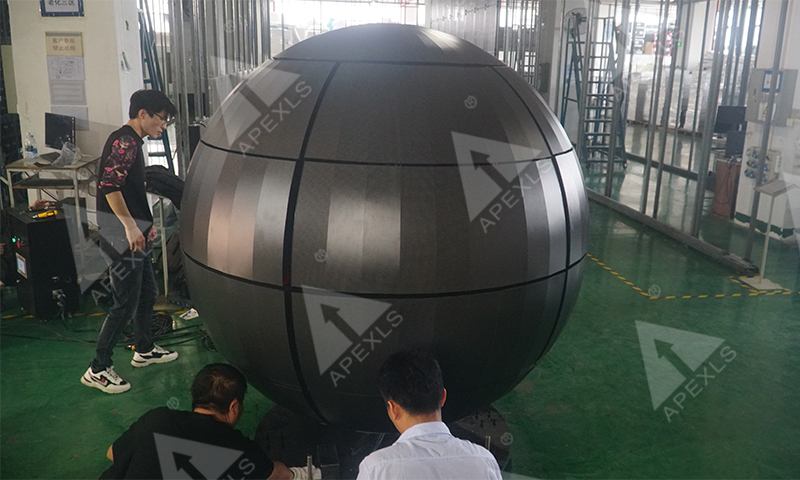
Trapezoidal LED modules use tapered edges and dimensions designed for specific positions within a spherical display. Their geometry helps accommodate changing circumferences across different latitudes.
Compared with adapting standard rectangular panels, custom-shaped modules can improve edge alignment and reduce unwanted gaps when paired with a properly engineered support structure.
The exact module shape depends on the sphere’s diameter, pixel pitch, curvature, and assembly method.
The supporting frame determines how accurately each LED module fits into the spherical structure. Precision-machined aluminum components can help maintain alignment, reduce cumulative assembly errors, and support a consistent screen contour.
Manufacturers should establish appropriate dimensional tolerances based on the display size, module design, and installation requirements.
Module masks and edge structures influence how viewers perceive the boundaries between adjacent panels. Carefully designed edges can reduce visible dark lines and improve visual continuity across the screen.
However, the final result also depends on LED placement, pixel pitch, module spacing, brightness uniformity, and viewing distance.
Even when the physical assembly is accurate, spherical displays require appropriate content mapping.
Video processors and rendering software can transform flat video content into a format suitable for a spherical screen. Depending on the display architecture, mapping methods may compensate for changes in viewing direction, pixel distribution, and geometric projection.
This process helps preserve the intended appearance of graphics, text, and images across different areas of the sphere.
| Comparison Factor | Rectangular Module Adaptation | Custom Trapezoidal LED Modules |
|---|---|---|
| Geometric fit | May require additional structural adjustments | Designed for specific spherical sections |
| Module alignment | Can be challenging as curvature changes | Tapered geometry can improve edge alignment |
| Visible seams | Gaps or uneven transitions may occur | Helps reduce visible gaps when properly assembled |
| Image mapping | Requires spherical content correction | Works with mapping software designed for the display |
| Structural design | May require more installation compromises | Supports application-specific frame engineering |
| Best suited for | Suitable designs with compatible geometry | Custom spherical and 360-degree LED displays |
The advantages of trapezoidal modules depend on the complete display design. Module geometry alone cannot guarantee a seamless surface or distortion-free imagery.
When planning a spherical LED display project, buyers should evaluate the following factors:
Discussing these requirements with the manufacturer early in the design process can reduce installation difficulties and improve overall display performance.
Custom trapezoidal LED modules help display manufacturers address the geometric challenges of spherical LED screens. By combining application-specific module shapes with precision structural frames and spherical video mapping, manufacturers can reduce visible seams, improve panel alignment, and minimize image distortion.
For museums, retail environments, exhibitions, and immersive installations, a coordinated approach to mechanical design and visual processing is essential for achieving a high-quality 360-degree display.
Looking for a spherical LED display tailored to your project? Explore the Apexls Indoor KSI Series Sphere LED Display.
Contact the Apexls team to discuss display dimensions, pixel pitch, module configuration, structural requirements, and customized project solutions.