
Immersive display technology is evolving rapidly. Consequently, many enterprises look closely at specialized immersive LED CAVE space solutions. However, buyers often confuse CAVE setups with a traditional LED giant screen. They assume it just means adding extra panels.
In reality, these systems differ fundamentally in architecture, user experience, and application scenarios. As an expert in custom creative LED screen engineering, Apexls provides an objective comparison across five core dimensions.
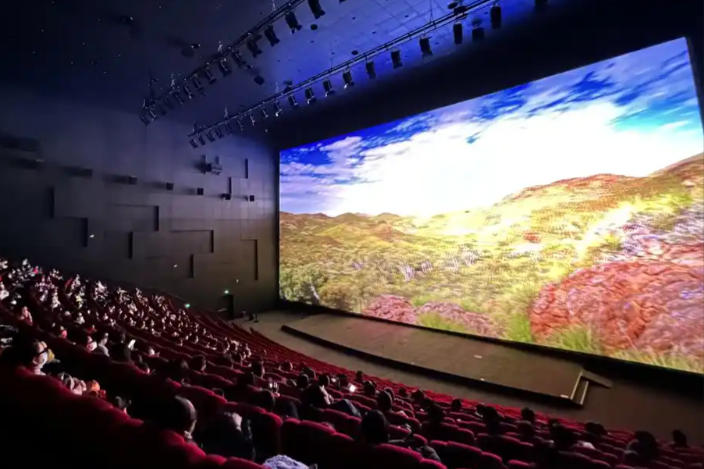
Traditional LED giant screens are fundamentally flat display devices. Regardless of screen size, the audience remains simple external viewers. A clear boundary always exists, which creates a natural barrier between viewers and digital content.
Conversely, an immersive LED CAVE space functions differently. The term CAVE means Cave Automatic Virtual Environment. Originally, researchers proposed this concept in 1992 at the University of Illinois.
The core design uses multiple displays to enclose a semi-closed environment. Typically, a high-end CAVE system consists of three to six synchronized LED walls. These include a front main screen, side walls, a floor screen, and sometimes a ceiling sky-screen.
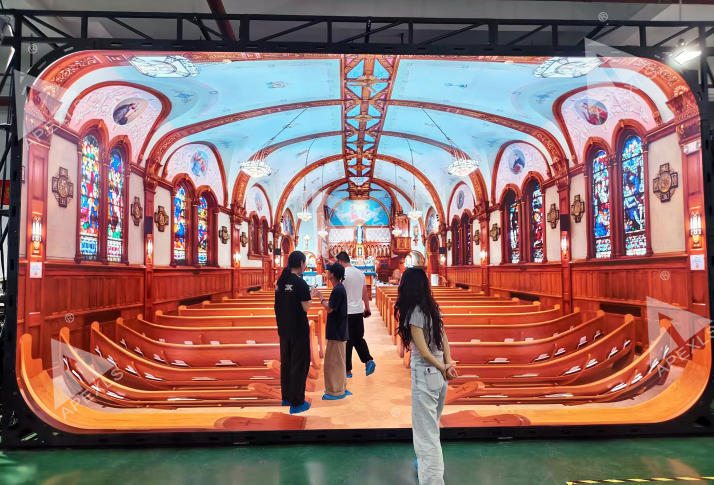
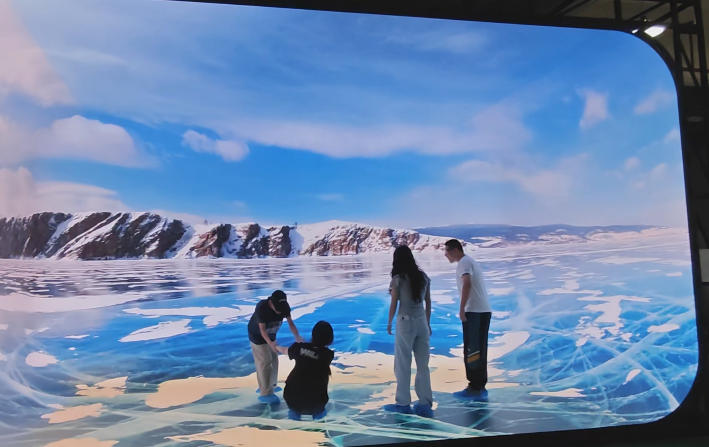
This design delivers a massive leap in spatial experience. Users no longer just watch a video. Instead, they step directly into the scene. Because screens cover their full field of view, users see continuous graphics when turning around. This setup achieves true environmental immersion.
Selection Guide: Choose traditional screens for standard promotional ads. However, choose CAVE spaces for virtual simulation training or interactive showrooms.
People frequently confuse the technical specs of these two formats. Yet, the mechanical differences remain highly distinct.
A standard giant screen utilizes a single flat surface. Its resolution depends on cabinet quantities and pixel pitch. Because audiences stand far away, pixel density demands remain relatively forgiving.
On the contrary, a CAVE space faces complex display challenges. Users stand extremely close to the LED walls, sometimes under one meter. Therefore, these environments demand ultra-fine pixel pitches.
For example, a premier research center deployed a five-sided LED CAVE in 2023. It utilized $P1.25$ fine-pitch LED panels to achieve 2400 * 2430 pixels per wall. Consequently, the total pixel count vastly exceeds that of a normal flat screen.
Furthermore, seamless mechanical splicing is critical. CAVE configurations require perfect alignment so users do not see corner crease lines. Modern custom creative LED screen engineering utilizes specialized curved corner modules. This engineering eliminates gaps and black lines.
Selection Guide: Deploy fine-pitch LED panels (P1.2 to P1.9) for close-up viewings. Relax these specs if audiences stay far away.
High brightness represents a massive advantage for LED configurations over traditional projector CAVE setups. For years, projector systems suffered from three major operational pain points:
Low Brightness: Projectors offer low brightness, usually between 100 and 300 nits. If ambient light enters, the images immediately become washed out.
Limited Contrast: Projectors rely on diffuse reflection, which limits deep black levels and contrast.
Disruptive Shadows: Users cast dark shadows when walking across the projection beam.
Modern LED CAVE technology eliminates these issues:
Superior Brightness: LED panels deliver 500 to 1500 nits effortlessly. They remain vivid under normal indoor lighting.
Infinite Contrast: Self-emitting pixels turn off completely for pure blacks, exceeding a 15000:1 contrast ratio.
Zero Shadows: The screen itself emits light, so walking users never create annoying shadows.
Selection Guide: Choose an LED CAVE if your venue has uncontrollable ambient light. Projectors only suit dark labs.
Long-term maintenance heavily impacts your overall return on investment. Projector setups require frequent lamp replacements every 2000 hours. Additionally, multi-channel projectors need complex edge-blending recalibrations periodically. Conversely, premium LED systems offer massive engineering advantages.
Extended Lifespan: LED modules operate for 80,000 to 100,000 hours. This duration equals over 27 years of daily use.
Modular Servicing: Technicians easily replace individual broken modules using convenient front-access magnetic tools.
Low Calibration: Once installed, the system rarely requires tedious recurring visual adjustments.
However, LED setups generate noticeable heat in enclosed areas. For instance, testing shows internal temperatures can exceed 30°C without proper ventilation. Therefore, integrating efficient airflow and air conditioning is necessary during the structural planning phase.
Selection Guide: Select modular LED hardware for high-frequency commercial operations. Ensure you allocate adequate budget for ventilation systems.
Interaction capabilities represent the most fundamental difference between these two technologies. A traditional LED giant screen focuses purely on one-way content playback. It lacks data return channels, so content cannot adapt to human movement.
In contrast, interaction serves as the true soul of a CAVE installation. A complete system integrates advanced optical tracking cameras to capture user head positions in real time.
It utilizes real-time perspective rendering to adjust graphics based on where the user looks. Furthermore, it supports multi-modal inputs like gesture recognition and data gloves.
This interactive capability unlocks advanced B2B workflows. For example, students can use digital pens to disassemble virtual aircraft engines safely.
Selection Guide: Choose a CAVE architecture with tracking sensors if your project requires human-machine collaboration.
| Feature Comparison | Immersive LED CAVE Space | Traditional LED Giant Screen |
| Viewing Position | Inside the display environment | Outside facing the display |
| Viewing Distance | Extremely close (under 1 meter) | Moderate to long distance |
| Visual Gaps | None (uses curved corner modules) | None (flat seamless splicing) |
| Tracking Systems | Integrates optical sensors | Purely playback hardware |
Both systems offer unique commercial display benefits. In summary, giant screens work best for passive broadcasting. Meanwhile, CAVE environments deliver unparalleled immersion for specialized simulation, education, and high-end corporate showrooms.
Apexls delivers comprehensive custom creative LED screen engineering services globally. We help you design, manufacture, and deploy next-generation interactive environments. Contact our engineering team today to schedule an expert technical consultation.
| Aspect | Traditional Large-Scale LED Screen | CAVE Immersive LED Space |
| Spatial Configuration | Single flat or curved screen (common) | Enclosed space with 3–6 surfaces |
| Viewing Experience | Audience “views” the image | User “steps into” the image |
| Resolution Requirement | Moderate (longer viewing distance) | High (close-range viewing; requires P1.2–P2.5) |
| Brightness/Contrast | Good | Excellent (500–1500 nits; contrast ratio >15,000:1) |
| Shadow Issues | None | None (self-illuminating LEDs) |
| Ambient Light Adaptability | Strong | Strong (compatible with standard indoor lighting) |
| Typical Lifespan | 80,000–100,000 hours | 80,000–100,000 hours |
| Maintenance Method | Modular | Modular (magnetic front-access maintenance) |
| Heat Dissipation Needs | Standard | High (requires specialized design for multi-sided enclosures) |
| Interactivity | None | Supports optical tracking, gesture recognition, and motion-based interaction |
| Capacity | Lower | Higher (requires multi-sided screens + tracking system) |