
In the traditional landscape of architectural media, digital screens have long been treated as “afterthoughts”—heavy, rectangular boxes bolted onto finished structures. This “mounted” approach often creates a visual conflict between the rigid geometry of the screen and the fluid curves of modern architecture. However, the emergence of bendable flexible LED displays has triggered a paradigm shift.
We are moving into an era where digital media no longer sits on top of a building; it “grows” from it. By transforming the display from an attached appliance into a “dynamic glowing skin,” flexible LED technology allows complex facades, circular columns, and sweeping domed ceilings to emit light and information autonomously. This article explores how these creative tools are dissolving the boundaries between structural engineering and digital art.
For decades, architects viewed LED screens as “pollution” that obscured the purity of their designs. The weight of steel supports and the bulk of cabinets made it impossible to maintain the integrity of a curved or organic structure.
Bendable flexible LED displays have changed this narrative. Instead of a rigid cabinet, these displays utilize a soft, rubberized, or silicone-based substrate. This flexibility allows the display to follow the “bones” of the architecture. Much like biological skin adapts to the contours of a body, flexible LEDs wrap around corners, flow into alcoves, and expand across domes without requiring invasive structural modifications.
By moving away from the rectangular “box” format, digital media becomes a fundamental building material. Architects can now treat “light” as a texture, similar to glass, stone, or metal. When a building facade can “self-illuminate” through a flexible skin, it ceases to be a passive object and becomes a living, breathing entity in the urban landscape.
The versatility of bendable flexible LED displays stems from a radical redesign of the traditional LED module.
Traditional LED panels often weigh over 20kg per square meter, requiring heavy-duty mounting brackets. Flexible modules, however, are incredibly thin—often less than 10mm—and lightweight. This reduction in mass allows for installation on surfaces that cannot support heavy loads, such as lightweight canopy structures or high-rise glass curtain walls.
Unlike standard screens, flexible LED ribbons and meshes can be cropped or daisy-chained to fit precise dimensions.
Curved Facades: Modules can bend both concavely and convexly, allowing them to follow wave-like walls.
Circular Columns: Because the modules can wrap in a complete 360-degree circle, they transform structural pillars into 3D information hubs without visible seams.
Geometric Irregularity: Whether the surface is a triangle, a trapezoid, or a sphere, flexible LEDs can be mapped to cover the area with mathematical precision.
In many commercial spaces, such as airports, shopping malls, and hotel lobbies, structural columns are “spatial obstacles.” Flexible LED technology turns these obstacles into the centerpiece of the environment.
When designers apply bendable flexible LED displays to a column, they eliminate the harsh “corners” associated with traditional flat-panel wrapping. This creates a continuous, panoramic canvas.
Visual Fluidity: Content can spiral up the column, simulating rising smoke, flowing water, or growing vines.
Spatial Navigation: In transit hubs, these “glowing pillars” act as dynamic wayfinding tools, pulsing with color-coded directions that guide passengers through complex terminals.
Neuro-aesthetic studies show that the human brain finds curved shapes more inviting and less threatening than sharp angles. By using flexible LEDs to create rounded, glowing surfaces, architects create “softened” commercial environments that encourage visitors to linger longer and engage more deeply with the brand.
The most ambitious application of flexible LED technology is the “Media Facade”—the transformation of an entire building exterior into a low-resolution or high-resolution digital art piece.
Traditional facades use external projectors or bolted-on billboards. These often ruin the building’s daytime aesthetics. Flexible LED meshes, however, can be integrated into the louvers or glass fins of a building.
Daytime Transparency: Many flexible mesh systems offer high transparency, allowing natural light to enter the building while maintaining the digital image on the outside.
Nighttime Transformation: As the sun sets, the building “activates.” The facade doesn’t just show an ad; it shifts its color, texture, and “mood” based on the weather, social media feeds, or local events.
By using low-power, high-efficiency flexible LEDs, buildings can achieve high-impact visual effects with a lower carbon footprint than traditional high-brightness floodlighting. This “Responsible Media” approach ensures that the building contributes to the city’s beauty without contributing to light pollution or excessive energy waste.
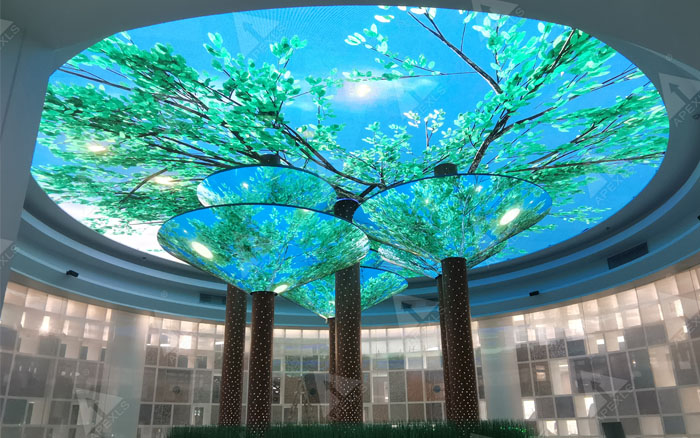
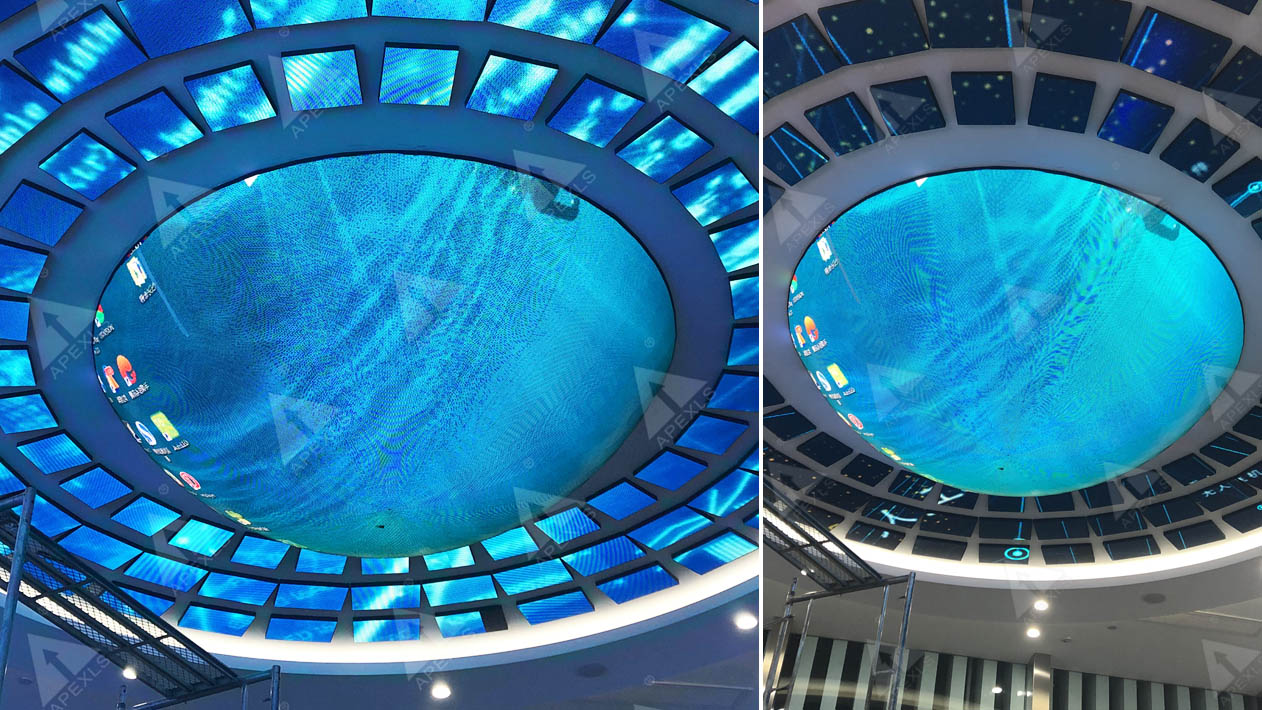
Ceilings are often the most underutilized surfaces in architecture. Bendable flexible LED displays allow for the creation of “Digital Skies”—massive, curved LED domes that redefine the sense of scale within a room.
In planetariums, luxury retail flagships, or high-end casinos, a curved LED dome can simulate a starlit sky, an underwater abyss, or a futuristic geometric vortex. The curvature of the LED surface mimics the natural periphery of human vision, creating a “VR without goggles” experience.
Because flexible LED modules are often perforated or made of lightweight materials, they do not interfere with the acoustic requirements of a large hall. They can be mounted to complex geodesic frames, ensuring that the “Digital Sky” remains structurally sound and visually perfect.
Beyond the aesthetic “wow factor,” the move toward flexible LED skins offers tangible commercial benefits.
Reduced Labor Costs: Magnetic mounting systems and “sticker-like” application methods for certain flexible LEDs drastically reduce installation time compared to heavy cabinet-based screens.
Unprecedented Creativity: Designers are no longer restricted by the “Screen Size” catalog. They can design the building first and “skin” it with light later.
Increased Asset Value: A building with a “Living Facade” becomes a local landmark. This increases the prestige of the address and the rental value of the commercial units within.
The evolution from “mounted” displays to “growing” skins marks the final step in the digitization of the physical world. Bendable flexible LED displays have liberated light from the rectangle, allowing it to flow, curve, and adapt to the complex visions of modern architects.
As we look toward the smart cities of the future, buildings will no longer be static monuments of concrete and glass. Instead, they will be dynamic, expressive canvases that interact with their surroundings. By turning facades, columns, and domes into “autonomous light sources,” flexible LED technology ensures that the architecture of tomorrow doesn’t just stand there—it communicates, it feels, and it glows.