

In the traditional philosophy of commercial architecture, structural elements like load-bearing columns and grand staircases were often viewed as “necessary obstacles.” Architects worked tirelessly to hide them or blend them into the background. However, the advent of cylindrical flexible LED displays has sparked a radical paradigm shift. No longer are these structures silent anchors; they have evolved into vibrant, “breathing” information organs that pulse with brand energy and artistic content.
By utilizing the ultra-thin and bendable characteristics of creative LED technology, designers can now “wrap” the skeleton of a building in a digital skin. This fusion of hardware and habitat turns a shopping mall atrium or a hotel lobby into a dynamic visual center. This article explores how cylindrical flexible LED displays redefine the symbiotic relationship between digital media and physical space, elevating both the technological prestige and the commercial value of modern environments.
In a high-traffic commercial environment, such as a luxury shopping mall or an international airport, space is the most valuable commodity. Large structural pillars often break the visual flow, creating “dead zones” that serve no promotional purpose.
When we apply cylindrical flexible LED displays to these pillars, we perform a form of architectural alchemy. The column ceases to be a barrier and becomes a 360-degree canvas. Because the human eye is naturally drawn to motion and light, a digital column acts as a “visual magnet,” pulling foot traffic toward specific areas of a retail space. By treating the building’s “bones” as a media interface, brands can communicate their message without occupying a single extra square meter of floor space.
Unlike rigid, flat screens that clash with the organic curves of modern architecture, flexible LED modules harmonize with the environment. They follow the contours of spiral staircases and flared columns perfectly. This “fusion design” ensures that the technology feels like an inherent part of the building’s DNA rather than an afterthought.
The technological soul of a cylindrical flexible LED display lies in its specialized PCB (Printed Circuit Board) design. Traditional LEDs use a rigid fiberglass substrate; however, creative flexible displays utilize high-grade silicone or reinforced soft-board materials.
Architects often worry about the structural load added by large-scale displays. Flexible LED modules are remarkably lightweight, often weighing 50% less than traditional cabinets. This low-profile design allows them to be magnetically attached to curved steel frames or even directly to concrete pillars using specialized adhesive systems. Consequently, the installation process is faster, and the impact on the building’s structural integrity is negligible.
One of the greatest challenges of circular displays is the “seam.” In a standard display, corners create a break in the content. Cylindrical flexible LED displays, however, utilize seamless splicing. The content flows around the column without a single visible gap or distortion. Whether it is a waterfall of cascading light or a panoramic brand video, the image remains continuous, providing an immersive experience for viewers walking around the structure.
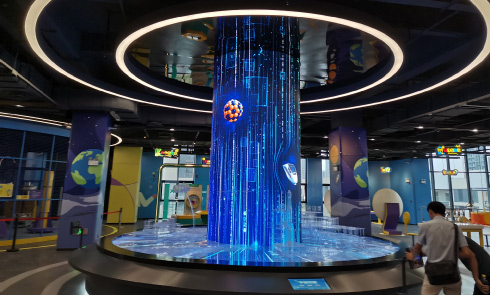
If the flexible LED is the “skin,” the content is the “breath.” A truly creative LED installation does not just play advertisements; it reacts to the rhythm of the space.
In a grand lobby, the “information organ” can reflect the time of day. In the morning, the column may display soft, rising sunlight and gentle natural textures. As evening approaches, it can transition into a sophisticated, pulsating artistic visualization that matches the city’s nightlife energy. This ability to “breathe” with the environment creates a profound psychological connection between the visitor and the space.
Flexible LEDs wrapped around staircases offer a unique opportunity for sequential storytelling. As a visitor ascends a spiral staircase, the content can move upward with them. Motion sensors can trigger visual “explosions,” or color shifts at the exact moment a foot touches a step. This level of interaction transforms a mundane physical act into a memorable brand experience, increasing the “stickiness” of the commercial venue.
While the beauty of cylindrical flexible LED displays is undeniable, their primary function is to drive commercial performance.
In a crowded mall, a flat screen is only visible from one direction. A circular LED column, however, offers 360-degree visibility. No matter where the consumer is standing, they are exposed to the brand message. This eliminates “blind spots” and maximizes the Return on Investment (ROI) for advertisers.
Research consistently shows that immersive, digitally-enhanced environments increase “dwell time”—the amount of time a customer stays in a location. The more time a consumer spends marveling at a creative LED installation, the more likely they are to engage with nearby retail outlets. The display acts as a landmark, a meeting point, and an entertainer, all while subtly reinforcing brand authority.
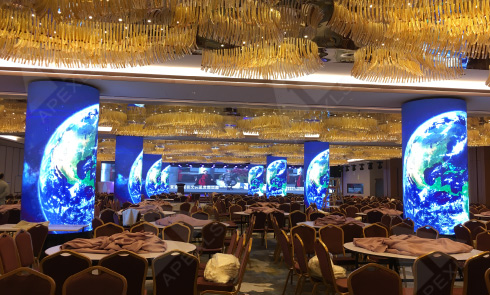
Designing for curves requires a higher level of engineering precision than designing for flats. To ensure these “information organs” function reliably, several technical factors must be addressed.
Heat Dissipation: Wrapping a display around a solid pillar can trap heat. High-quality cylindrical flexible LED displays utilize specialized thermal-conductive materials and ventilated sub-frames to ensure the LEDs stay cool, preventing color shift and extending the lifespan of the diodes.
Maintenance Accessibility: Most creative installations utilize “front-maintenance” modules. Since the screen is wrapped around a permanent structure, technicians must be able to remove and replace individual modules from the outside without dismantling the entire column.
Pixel Density and Viewing Distance: Because columns are often at eye level, a fine pixel pitch (such as P1.8 to P2.5) is critical. This ensures that the content remains sharp and vibrant even when a customer is standing just a few centimeters away.
The era of the “dumb” pillar is over. As cities become smarter and commercial spaces become more competitive, the integration of cylindrical flexible LED displays will become a standard requirement for world-class architecture.
By transforming structural necessities into digital “information organs,” we unlock a new dimension of human-machine interaction. These displays do more than show data; they provide a heartbeat to the building. They turn a static environment into a living, breathing experience that captivates the senses and elevates the brand. In the hands of a visionary designer, a simple column is no longer a support beam—it is a portal to a digital world, a focal point of beauty, and a powerful engine for commercial growth.