
A spherical LED display for trade show booths gives exhibition designers, booth builders, and brand marketing teams a distinctive way to attract attention in crowded exhibition halls. Unlike conventional rectangular screens, a spherical LED display presents digital content across a curved, three-dimensional surface. Its 360-degree viewing effect can help brands communicate from multiple directions and create a recognizable focal point within an exhibition space.
For B2B exhibitors, the value goes beyond appearance. A well-planned LED sphere display can support product storytelling, campaign launches, interactive presentations, and branded environments. However, its effectiveness depends on more than screen shape. Content design, pixel pitch, viewing distance, structural support, installation conditions, and overall booth layout all influence the final result.
This guide explains why spherical LED displays work well at trade shows and what project teams should evaluate before incorporating one into a custom exhibition booth.
Trade show visitors encounter competing graphics, product demonstrations, lighting effects, and digital screens throughout an exhibition hall. A distinctive display structure can help a booth establish a visual identity before visitors approach its products or speak with its team.
Traditional flat screens are useful for product specifications, presentations, and promotional videos. However, their rectangular format can blend into exhibition environments that already contain many similar displays.
A spherical LED display introduces a different visual geometry. Its rounded form can become the centerpiece of a booth, drawing attention upward or toward a designated viewing area.
Exhibition designers can use this effect to:
The sphere should complement the booth’s overall concept rather than compete with every other design element. A clear focal point usually creates a more coherent visitor experience than several unrelated visual attractions.
A conventional flat display generally directs attention toward one primary viewing area. By contrast, a spherical LED screen can present visuals across its curved surface, allowing visitors to view content from different positions around the display.
This characteristic is particularly useful for island booths, central exhibition zones, and open layouts with multiple approach paths.
For example, a technology brand could display animated data, product imagery, or abstract digital patterns on a sphere positioned above a central demonstration area. Visitors approaching from different directions may encounter the same visual centerpiece without needing to stand directly in front of a flat screen.
Actual visibility depends on the installation height, booth layout, surrounding structures, and content. A spherical display does not guarantee that every viewer will see every detail clearly from every position.
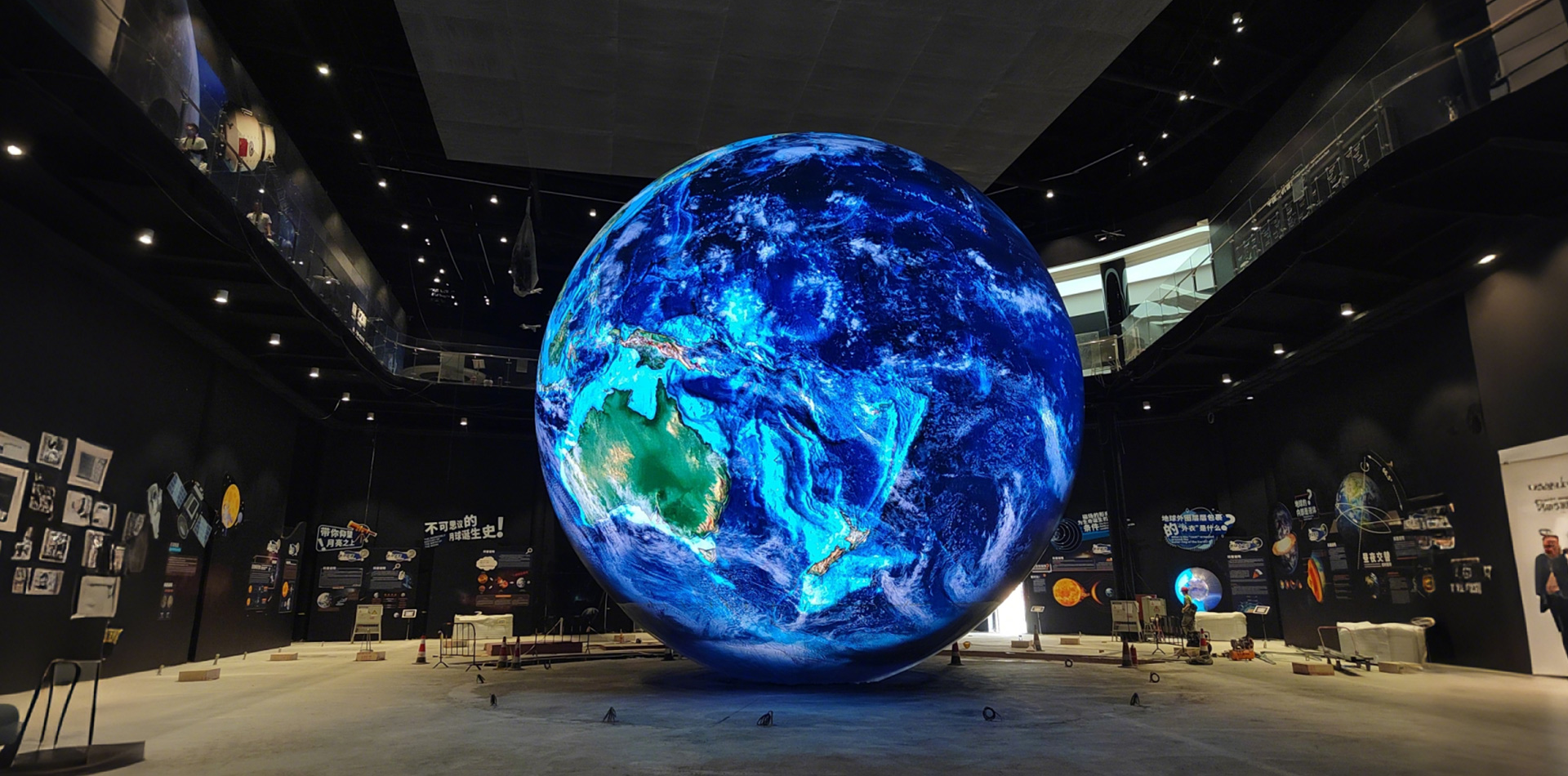
A spherical screen can serve several functions within a trade show booth. Its role should be defined during the design stage so the display supports the brand’s objectives and visitor journey.
A distinctive screen shape gives designers another way to express a brand’s visual language. Instead of relying only on printed graphics, logos, and rectangular video walls, teams can integrate digital motion into the booth’s architectural concept.
Possible applications include:
For effective branding, teams should plan how the logo, key message, and product imagery will appear across the curved surface. Text that looks clear on a computer monitor may become difficult to read when wrapped around a sphere.
A spherical LED display can support product storytelling when a brand needs to communicate complex ideas quickly.
For example, an industrial technology company might use animated visuals to illustrate connected systems, data flows, or equipment applications. A consumer electronics brand could display product details and campaign imagery through a sequence of coordinated scenes.
The content should match the display’s geometry. Large visual elements, recognizable shapes, and carefully composed animation generally translate more effectively to a spherical canvas than dense paragraphs or small technical labels.
A spherical LED screen can contribute to an immersive booth when designers coordinate it with lighting, architectural elements, product displays, and other audiovisual systems.
A coordinated environment may include:
The goal is to create a unified experience rather than simply add another screen. The sphere should have a clear relationship with the products, messages, and activities that visitors encounter elsewhere in the booth.
Product launches often rely on a combination of anticipation, visual storytelling, and a clearly defined presentation moment. A spherical LED display can serve as a central visual element during countdowns, reveals, and scheduled brand presentations.
For example, a brand could begin with abstract motion graphics, transition into a product-themed animation, and then display the campaign’s main message.
Before the event, the production team should confirm the media playback system, content format, resolution, playback timing, and synchronization requirements. If the screen must coordinate with stage lighting, audio, or other displays, these systems should be tested together before the exhibition opens.
A visually distinctive installation can give visitors a reason to pause and investigate the surrounding exhibition space. This creates an opportunity for booth staff to introduce products, arrange demonstrations, or begin conversations with potential buyers.
However, attention alone does not guarantee qualified leads. The display should connect to a clear visitor journey, such as:
This approach helps marketing teams evaluate the display as part of the wider exhibition strategy rather than as an isolated visual installation.
A successful installation begins with practical design coordination. Exhibition companies should assess the display’s dimensions, mounting method, content requirements, and venue restrictions before finalizing the booth structure.
The appropriate mounting method depends on the sphere’s size, weight, structural design, booth footprint, and exhibition regulations.
Common installation approaches include:
Apexls lists floor-mounted, hanging, and embedded installation options for its spherical display solutions. The available method should be confirmed for the selected model and project design. See the Apexls spherical LED display range.
Before production, confirm ceiling load limits, rigging points, floor loading, access routes, emergency exits, and the venue’s installation rules. A visually attractive concept is only practical when it meets the site’s structural and operational requirements.
Pixel pitch refers to the distance between adjacent LED pixels. It affects image detail, viewing distance, and display configuration.
A smaller pixel pitch can support finer detail at closer viewing distances, while a larger pitch may suit larger displays viewed from farther away. The correct selection depends on the sphere’s diameter, the expected audience position, the content, and the project budget.
| Design consideration | What buyers should evaluate |
|---|---|
| Typical viewing distance | Where visitors will stand during normal booth activity |
| Content detail | Whether the screen shows abstract visuals, product imagery, or text |
| Sphere diameter | How the overall scale affects visibility and viewing angles |
| Pixel pitch | The balance between image detail and project cost |
| Audience movement | Whether visitors approach from one side or circulate around the display |
For instance, a booth featuring a large animated brand graphic may have different resolution requirements from one displaying detailed product information. The pixel pitch should be selected around the intended viewing experience, not chosen by specification alone.
Apexls lists indoor spherical display options with pixel pitches including P1.875, P2, P2.5, P3, and P4 across its product range. Available combinations depend on the selected model and sphere diameter. Check the indoor KSI spherical LED display specifications when developing an initial specification.
A spherical LED display is part of a wider electrical and structural installation. The booth design must account for power distribution, signal connections, heat dissipation, controller access, and maintenance procedures.
Before confirming the layout, ask the supplier to provide or verify:
These details become especially important for temporary exhibitions, where installation windows may be short and the equipment may need to be transported between venues.
A spherical LED display requires content designed for its geometry. Simply stretching a conventional rectangular video across a sphere can create distorted graphics, misplaced text, or awkward transitions.
Content creators should work with the display supplier to confirm the screen’s mapping method, pixel layout, media format, and playback system.
Useful content principles include:
If the campaign requires precise text, product specifications, or calls to action, a supporting flat screen may be more appropriate for those elements. The sphere can then focus on visual storytelling and brand recognition.
The content strategy should reflect what the brand wants visitors to remember or do.
| Exhibition objective | Suitable content approach | Planning priority |
|---|---|---|
| Brand awareness | Brand colors, logo animations, distinctive visual motifs | Recognition and consistency |
| Product launch | Product reveal sequences and campaign visuals | Timing and message clarity |
| Technical demonstration | System animations and simplified process visuals | Accuracy and legibility |
| Lead generation | Campaign visuals coordinated with booth staff | Clear visitor next steps |
| Corporate presentation | Brand story, milestones, and key business themes | Readable, organized information |
For a multi-day event, the content team can prepare several coordinated scenes. This keeps the display visually active while allowing the booth to highlight different products, audiences, or campaign messages throughout the day.
A spherical LED display and a flat LED screen serve different purposes. The right choice depends on whether the project prioritizes a distinctive visual centerpiece, detailed information, or a combination of both.
| Evaluation factor | Spherical LED display | Conventional flat LED display |
|---|---|---|
| Visual form | Three-dimensional, rounded structure | Rectangular screen surface |
| Viewing approach | Can support viewing from multiple directions | Primarily designed around a front-facing audience |
| Main strength | Distinctive centerpiece and curved visual storytelling | Direct presentation of text, charts, and rectangular video |
| Content preparation | Requires content mapping suited to the spherical geometry | Often uses conventional rectangular media formats |
| Booth integration | Works well as a focal point or suspended feature | Works well as a backdrop, presentation screen, or information panel |
| Space planning | Requires consideration of the sphere’s full dimensions and support structure | Requires consideration of screen dimensions, mounting, and viewing area |
These formats are not mutually exclusive. A hybrid booth can use a spherical LED display to attract attention and communicate campaign themes, while flat screens provide detailed product information and sales presentations.
For exhibition design companies, the best configuration is the one that connects the display format to the visitor journey and the client’s marketing objectives.
For exhibition contractors and brand teams, early coordination reduces the risk of specification changes, installation delays, and content rework.
Use the following checklist during supplier evaluation.
Display configuration
Structural and installation requirements
Content and system integration
Commercial and project coordination
For temporary exhibitions, also consider how easily the system can be transported, assembled, dismantled, and reused. A reusable design may offer operational value across multiple events, but this depends on the structure, handling requirements, and actual usage frequency.
A custom spherical LED display project involves more than selecting a screen diameter. The display geometry, LED modules, structural support, control system, and content workflow must work together.
For exhibition design companies and booth builders, a capable supplier should help clarify technical requirements before manufacturing begins.
When evaluating a supplier, look for:
Apexls offers indoor and outdoor spherical LED display product ranges, with model-dependent size and pixel-pitch options. Buyers can review the spherical LED display product range and discuss project requirements with the supplier before finalizing a booth design.
The most suitable supplier is not necessarily the one offering the largest sphere or the finest pixel pitch. It is the one that can match the technical configuration to the venue, content, budget, and installation plan.
A spherical LED display creates a distinctive three-dimensional focal point and can present visuals to visitors approaching from multiple directions. It is useful for brand storytelling, product launches, and visually driven exhibition concepts.
Start with the expected viewing distance, sphere diameter, content detail, and budget. Smaller pixel pitches can support finer detail at closer distances, but the final choice should be based on the actual installation and content requirements.
It can display video, but content may require mapping or adaptation to the spherical surface. Ask the supplier for the required resolution, media format, playback specifications, and a content preview workflow before production.
Some spherical display configurations support suspended installation. However, feasibility depends on the model, structural design, display weight, venue rigging capacity, and applicable safety requirements. Obtain engineering documentation and venue approval before installation.
Neither format is universally better. A spherical display is well suited to distinctive visual focal points and curved storytelling. A flat LED screen is often more practical for detailed text, charts, and conventional presentations. Some booths benefit from using both.
Provide the target sphere diameter, intended venue, viewing distance, preferred pixel pitch if known, content type, mounting method, power requirements, event schedule, and budget range. Drawings or booth renderings can help the supplier assess structural integration and technical feasibility.
A spherical LED display for trade show booths can transform a conventional exhibition layout into a more distinctive brand environment. Its rounded form, multi-directional viewing potential, and support for dynamic visual storytelling make it a valuable option for exhibition designers, booth builders, and marketing teams seeking a strong visual centerpiece.
The best results come from coordinating the display with the booth architecture, audience movement, pixel pitch, content mapping, installation requirements, and marketing objectives. A well-designed sphere should do more than attract attention. It should help visitors understand the brand, explore the products, and take the next step in their buying journey.
For teams planning a custom exhibition project, Apexls can be contacted to discuss spherical LED display configurations, technical requirements, and design integration options. Define the intended application and installation conditions first, then select a solution that fits the project’s visual goals and practical constraints.