A plain-English guide to the latest non Gamstop casinos UK 2026, covering offshore licences, no deposit bonuses, real brands, and what to check before you deposit. read the latest non Gamstop casino guide


Digital technology consistently reshapes modern exhibition experiences worldwide. Today, immersive LED showrooms transform traditional spaces into multi-dimensional brand environments. These systems serve as the visual core for corporate showrooms and science museums. Therefore, a premium design directly determines the final display success. Apexls delivers full-process solutions from environment analysis to final project deployment.
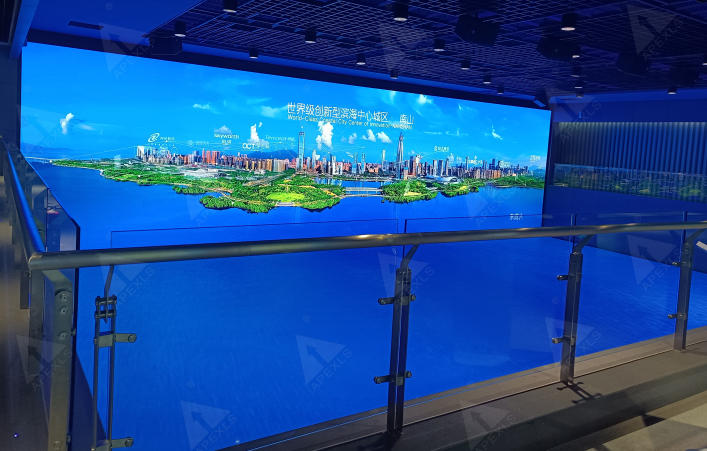
Before launching any design, engineers must conduct a comprehensive environmental analysis. These initial conditions dictate the creative LED display custom hardware selection.
Lighting Condition Assessment
Showroom lighting heavily impacts overall visual performance. For instance, high-light environments require ultra-high brightness screens over 1000 cd/m². In contrast, dark environments benefit from adaptive dimming technologies to protect visitors’ eyesight. Operators can utilize dynamic sensor modules to balance indoor lighting automatically.
Spatial Layout and Viewing Distance
Viewing distance dictates the ideal pixel pitch choice. For example, small 20-square-meter showrooms perform best with P1.5 to P2.5 displays. Standard 100-square-meter spaces usually require P2.5 to P3 models. Furthermore, curved screens need an eight-meter radius to maximize the sense of human visual enclosure.
Acoustics and Thermal Management
True immersive experiences require seamless audio-video synchronization. Therefore, teams must plan acoustic placement and sound absorption early. Additionally, massive screens generate significant thermal energy during continuous operation. Engineers should install silent cooling fans or air conditioning systems to prevent overheating failures.
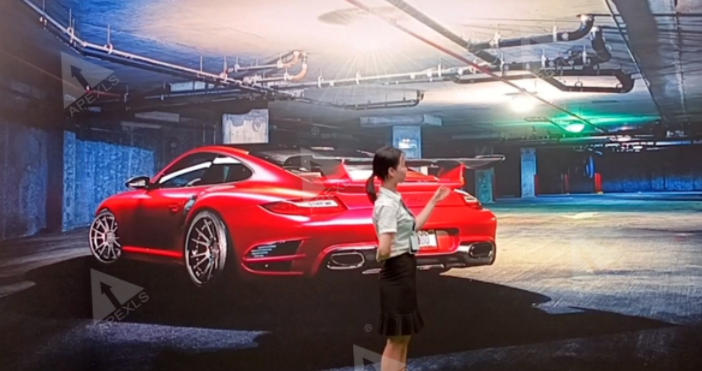
Different showroom types require distinct hardware layouts to achieve maximum engagement.
Showroom Classification
Curved/Wrap-around Spaces: U-shaped screens wrap around three sides to create semi-enclosed retail environments.
CAVE Immersive Spaces: Left, center, right, floor, and ceiling displays form a fully enclosed visual box.
Dome/Sky Theaters: Spherical screens cover the entire overhead view to present flawless panoramic views.
LED Hardware Options
First, small-pitch LED screens support ultra-high-resolution content below P2.5. Second, flexible curved screens adapt perfectly to unusual architectural pillars. Third, heavy-duty interactive LED floor tiles track human footsteps to create real-time movement effects. Fourth, transparent film screens adhere directly to window glass without blocking natural ambient light.
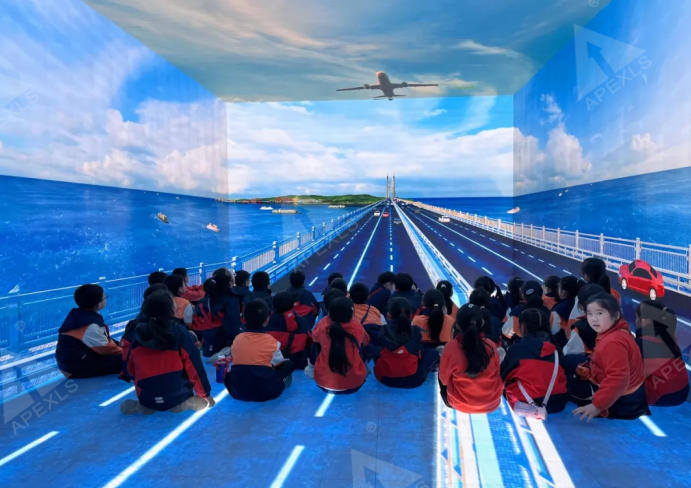
Great showroom design relies on a logical narrative structure. Specifically, designers separate the visitor journey into four distinct sequential zones.
The entry zone utilizes curved screens to deliver a powerful first impression. Next, the core area uses a massive CAVE LED display system to present main brand stories. The interactive zone features touch tables and floor sensors to transform visitors into active participants. Finally, the relaxation zone provides comfortable seating alongside small informational displays.
Key Display Specifications
Pixel Pitch: Choose P1.2 to P1.5 for close interactions, and P1.8 to P2 for distant views.
Brightness Control: Maintain standard indoor levels around 500 cd/m² to prevent user eye fatigue.
Contrast Ratio: Ensure a minimum 3000:1 sequential contrast ratio for deep black levels.
Refresh Rate: Deploy premium hardware with a 3840Hz refresh rate to eliminate camera flickering.
Control and Transmission Setup
Industrial controllers handle high-resolution 4K or 8K video outputs simultaneously. Furthermore, long-distance signal transmission relies on fiber optic cables with standard network cable backups. This dual setup guarantees zero signal latency across one hundred meters.
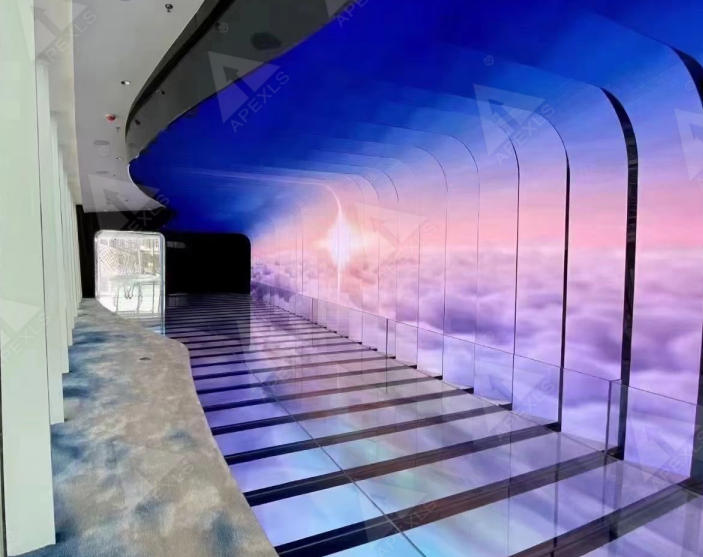
Advanced Display Control
Modern control platforms support multi-screen roaming, overlaying, and flexible scaling. These platforms run smoothly on Windows and Android operating systems. For instance, cloud-based scheduling allows managers to update global media files instantly from remote locations.
Creative Content Strategy
Content remains the true soul of any immersive environment. Corporate showrooms focus on product value, while cultural museums highlight emotional history. Production teams should combine local cultural elements with striking digital art. This combination creates a memorable visual journey for younger target audiences.
Structural Mounting Options
Technicians choose wall-mounted, embedded, or hanging structures based on building load capacities. Complex shapes like a stepped screen or a spherical LED screen require precise 3D modeling first. For example, large dome installations use custom-engineered cabinets with unique curved dimensions to guarantee smooth visual surfaces.
Rigorous Calibration Process
The final calibration stage includes three essential steps:
Perform pixel-by-pixel brightness correction to ensure flawless color uniformity.
Test all digital input sources to guarantee smooth video switching.
Calibrate radar sensors to ensure rapid touch response speeds.
Daily Care Protocols
Maintenance workers clean exterior dust regularly and check internal power supplies. Small-pitch models use magnetic front-service modules for fast repairs. Consequently, technicians can replace a damaged module within a few seconds.
Smart Energy Management
IoT management platforms track real-time power consumption and overall equipment health. This smart automation delivers up to thirty percent energy savings. Furthermore, digital twin software integration speeds up content updates by three times.
Designing large-scale LED screens for immersive exhibition halls is a systematic undertaking that encompasses multiple dimensions, including environmental assessment, display selection, spatial storytelling, hardware integration, content development, installation, and ongoing maintenance. Throughout the design process, the core principle of “visitor-centricity” must be upheld, transforming the LED display system from a mere tool for information presentation into the central medium for the spatial experience.
LED display technology is currently evolving toward finer pixel pitches, non-standard shapes, and greater intelligence. Fine-pitch LEDs are rapidly replacing LCDs in high-end indoor settings; the ability to integrate content with systems has become a key competitive advantage; and intelligent management platforms are becoming standard features in large-scale projects. Driven by the deep integration of technologies such as AI, digital twins, and 5G, future immersive exhibition halls will evolve in three key directions: real-time content updates via cloud-based libraries, personalized experiences enhanced by biometric technology, and zero-carbon operations achieved through energy management systems. Only by deeply integrating cutting-edge technology with human-centric design can we create future exhibition spaces that offer both visual impact and emotional resonance.