A plain-English guide to the latest non Gamstop casinos UK 2026, covering offshore licences, no deposit bonuses, real brands, and what to check before you deposit. read the latest non Gamstop casino guide

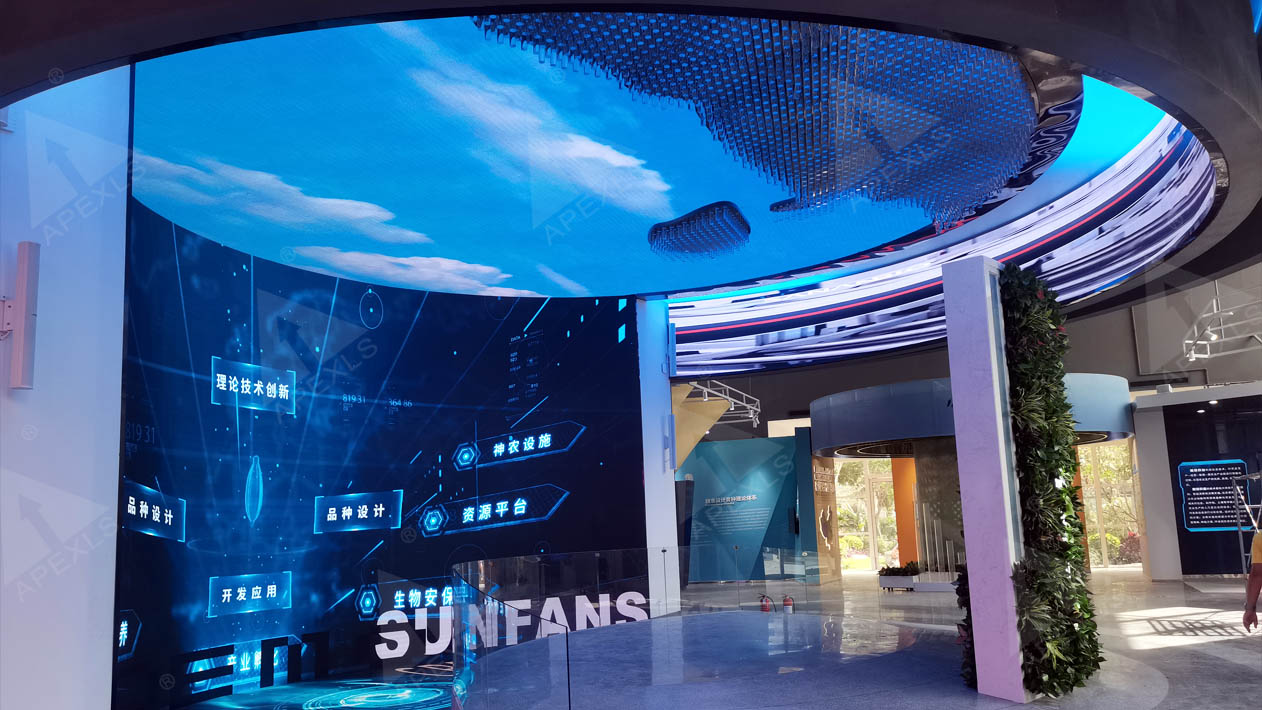
In the traditional history of visual media, the screen has always been a “window”—a rectangular frame that we look at from a distance. However, the emergence of LED ultra-clear dome screens has shattered this frame, evolving the screen from a window into a “world.” By enveloping the viewer in a 360-degree, dead-zone-free visual environment, the dome screen moves beyond simple display technology to become the ultimate “Dream Machine.”
Whether it is transporting students to the edge of a black hole in a planetarium, drowning art enthusiasts in the swirling brushstrokes of Van Gogh, or elevating a luxury brand’s narrative to a mythological scale, the dome screen deconstructs the traditional observer-subject relationship. It replaces “watching” with “inhabiting.” This article explores the philosophical and technical mastery of LED dome technology and how it is redefining the paradigm of immersive experience.
The human field of vision is not a flat rectangle; it is an arc. Standard screens constantly remind us of their boundaries, breaking the illusion of reality. LED ultra-clear dome screens align with the natural curvature of human sight, providing a peripheral immersion that triggers a “presence” response in the brain.
In a dome environment, there is no “edge.” When the visual content extends above and behind the viewer, the brain stops processing the screen as a piece of hardware and starts processing it as a sky. This psychological shift is the foundation of the “Dream Machine.” It allows creators to build narratives that don’t just tell a story but envelop the audience within it.
Because a dome screen can simulate a complete horizon, it can effectively manipulate the viewer’s sense of gravity. In a planetarium setting, as the stars move across the curved ceiling, the audience feels a physical sensation of “floating” or “tilting.” This vestibular-visual interaction is a unique capability of LED dome technology that no flat screen, no matter how large, can replicate.
Traditional planetariums relied on optical-mechanical projectors or laser projection. While poetic, these systems often struggled with brightness, contrast, and the “gray sky” effect.
LED ultra-clear dome screens bring self-emissive technology to the cosmos.
True Black Levels: In space, black is not dark gray; it is absolute. LED technology allows for individual pixels to turn off completely, creating a contrast ratio that makes stars look like brilliant diamonds set against an infinite void.
High Dynamic Range (HDR): When a digital sun rises over a Martian landscape on an LED dome, the brightness is visceral. The ultra-high nit levels allow for a realistic simulation of light that projection systems simply cannot match, turning a lecture into a cinematic voyage.
The “Immersive Art” movement has taken the world by storm, but the quality of the immersion depends entirely on the fidelity of the canvas.
Imagine standing beneath a 20-meter dome where Van Gogh’s The Starry Night is not just projected, but rendered in ultra-high definition.
Micro-Pitch Precision: With the fine pixel pitch of modern LED modules, viewers can see the “topography” of the oil paint. Every swirl of the brush becomes a massive, moving wave of color that “swallows” the viewer.
Color Uniformity: Modular LED domes ensure that the color remains consistent from the base of the wall to the apex of the ceiling. This seamlessness is critical for art exhibitions, where a slight shift in color temperature between panels would shatter the artistic integrity of the work.
In the competitive world of luxury retail, the goal is no longer just to sell a product, but to initiate the consumer into a brand’s mythology.
In a flagship store, an LED ultra-clear dome screen can transform a simple ceiling into a celestial canopy.
Mythological Scale: A watch brand can show the intricate movements of a tourbillon expanding across the ceiling, with gears the size of houses turning overhead.
Creating an “Oasis”: For a brief moment, the shopper is removed from the noise of the street and placed inside a curated universe. This level of environmental control allows brands to command a higher emotional price point, as the product is no longer an object—it is a relic of the “dream” the screen has created.
5. Engineering the Impossible: The Tech Behind the Magic
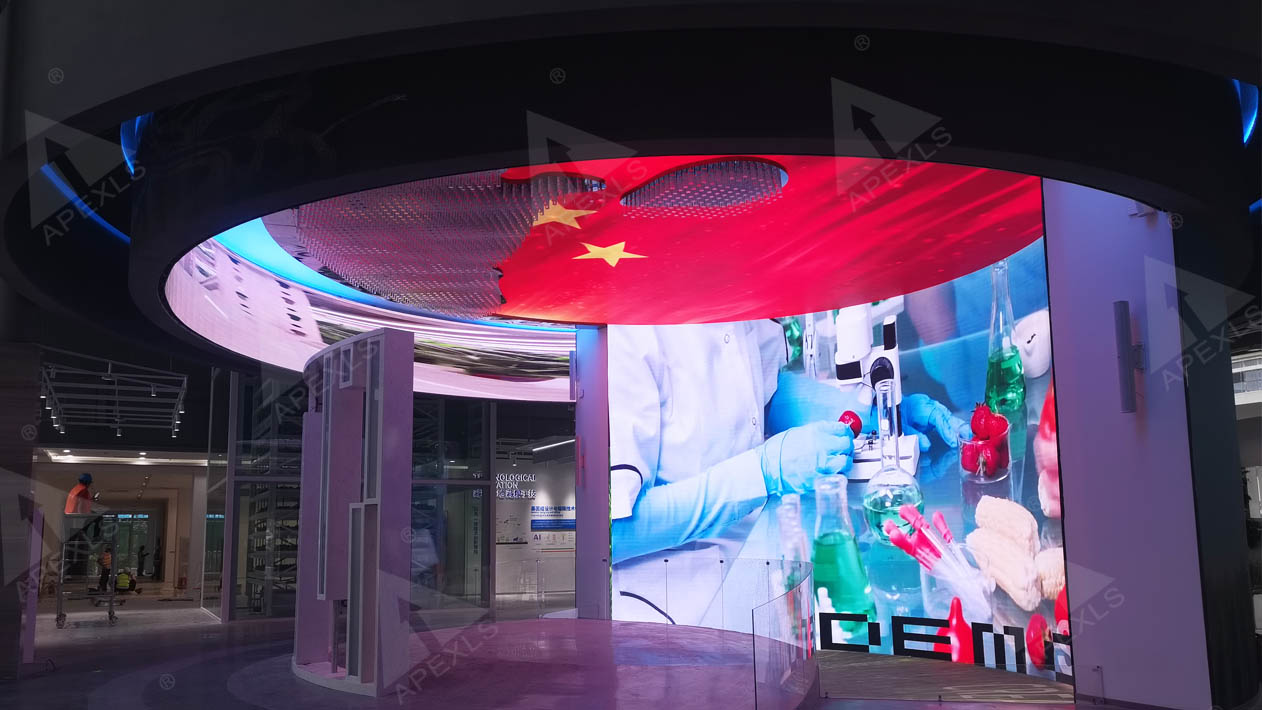
Building a dome out of flat LED modules is a feat of extreme geometric engineering. It requires a “Creative Modular” approach that Apexls-level technology excels at.
Triangle & Trapezoid Modules: To create a perfect sphere without gaps, engineers use custom-shaped LED modules. These “puzzle pieces” are designed to fit the specific radius of the dome, ensuring a smooth, continuous surface.
Heat Dissipation and Acoustics: A dome acts like a giant parabolic mirror for both heat and sound. Advanced LED ultra-clear dome screens feature silent, fanless cooling and acoustically transparent structures that allow sound systems to be placed behind the screen, ensuring the audio is as immersive as the video.
Real-Time Warping and Mapping: Specialized video processors “warp” the content in real-time to fit the curved surface without distortion, ensuring that a straight line in the digital file looks like a straight line on the dome.
The LED ultra-clear dome screen is the final frontier of display technology. It is the tool that finally allows us to step through the screen and into the imagination of the creator. By mastering the physics of light and the geometry of the curve, we have created a medium that speaks to the ancient human instinct of looking up at the sky in wonder.
Whether it serves science, art, or commerce, the dome screen is a “Dream Machine” that redefines what it means to experience a story. It is no longer about what we see, but about where we are. In the future of experiential spaces, the most powerful tool is the one that removes the walls and replaces them with the infinite.