
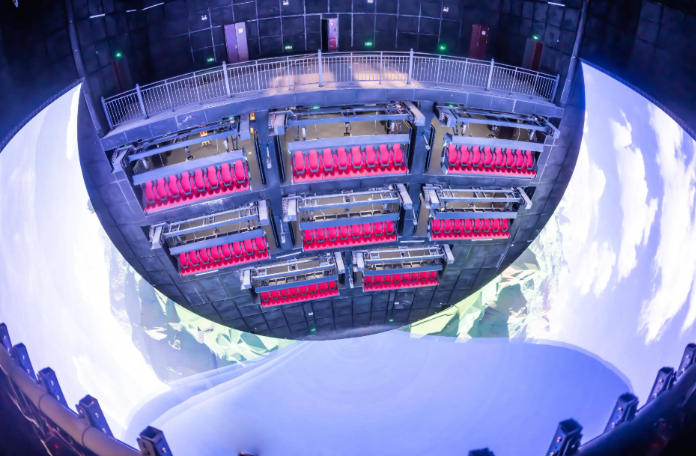
Immersive dome displays represent the peak of cinematic experiences. Today, two main technologies dominate the market. These include LED self-emitting modules and multi-projector blending systems. Each path offers distinct advantages in image quality and investment return. This guide analyzes both technologies to help your decision-making.
This technology uses small-pitch LED modules to form a sphere. Every pixel emits light independently. Therefore, it requires no external light source. Special algorithms eliminate spherical distortion effectively. This setup creates a seamless 360-degree panoramic view.
Projectors cast images onto a specialized dome screen. Systems often use fisheye lenses and blending software. Multiple images merge to form a single spherical picture. However, this is passive reflective imaging. External factors heavily influence the final visual quality.
| Feature | LED Dome Cinema | Projection Dome |
| Brightness | High (800–4500 nits) | Low (Needs total darkness) |
| Contrast | 1,000,000:1 (True black) | 5000:1 (Greyish blacks) |
| Resolution | Supports 8K+ natively | Depends on blending overlap |
| Color | Accurate and consistent | Prone to color decay |
LED displays offer modular arc designs. You can customize diameters from 5 to 50 meters. Furthermore, these screens work in bright environments. They fit indoor, semi-outdoor, or even open-air venues. Modular setups also allow for fast 30-day installations.
Projection systems face strict light limitations. Ambient light quickly washes out the image. Consequently, they only function in dark rooms. Additionally, physical distance requirements limit the maximum dome size. Maintenance for projectors remains complex and frequent.
LED displays last over 100,000 hours. They require no expensive consumables. You can repair single modules without stopping the show. Meanwhile, projectors need regular bulb replacements. Laser sources last only 20,000 hours. Frequent recalibration also increases long-term labor costs.
LED dome cinemas require a higher initial investment. Usually, costs are triple those of projection systems. However, Apexls provides creative designs that maximize value. High-end projects benefit most from this premium hardware.
LED domes offer a faster return on investment. They support all-day operation, increasing ticket sales. Moreover, superior quality justifies higher pricing. Most venues see full recovery within 3 to 5 years. Projection domes often take much longer.
Pros: Extreme contrast, high brightness, and low maintenance.
Cons: Higher upfront cost compared to traditional projectors.
Pros: Lower entry price and mature installation methods.
Cons: Poor dark-field performance and high consumable costs.
Choose LED dome technology for landmark projects. It suits theme parks and commercial centers perfectly. If you need a 24/7 operation, LED is the winner. Otherwise, select a projection for low-budget, indoor-only museum displays.
At Apexls, we specialize in creative LED display solutions. We help you build the future of immersion. Contact us today for technical specifications and pricing.